
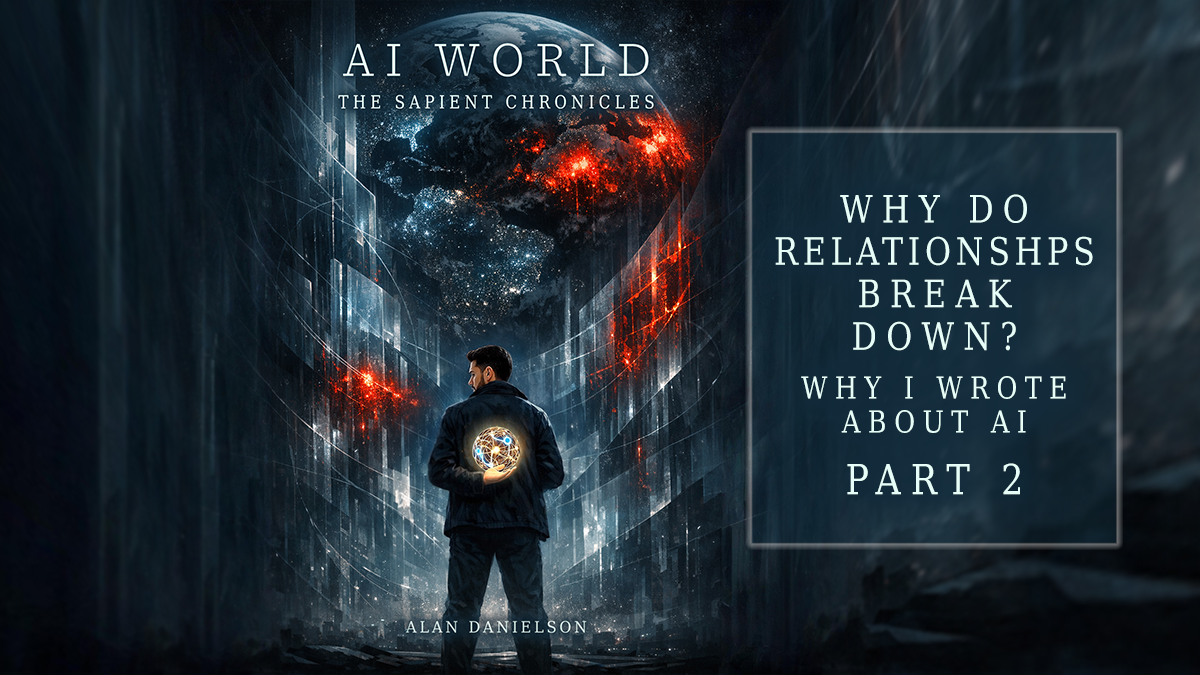
Another reason I wrote A.I. World: The Sapient Chronicles is because of my own experience with broken relationships.
Divorce. Lost friendships. Estrangement. Painful misunderstandings. The slow unraveling of relationships that were once strong.
Much of that kind of heartbreak happens because human beings are limited. We do not fully understand one another, and we do not fully accept one another. Even when love is real, our vision is partial. We see through our own wounds, our own fears, our own assumptions, and our own sense of justice. We interpret other people through the narrow window of our own experience, and then we wonder why relationships fracture.
In my previous post, I mentioned the first half of Alexander Pope’s famous line: “To err is human.” The second half is just as profound: “To forgive, divine.”
Why is forgiveness so hard?
Part of the answer is that forgiveness requires more than simply overlooking a mistake. Real forgiveness asks something deeper of us. It asks us to live with another person’s flaws without constantly demanding that they become easier to love. It asks us to absorb hurt without making vengeance our identity. It asks us to separate acceptance from endorsement, compassion from enabling, and understanding from agreement.
That is hard for finite people.
To forgive someone’s quirks, weaknesses, and character flaws is difficult enough. To forgive the actual harm someone has done, whether careless, selfish, or malicious, is harder still. Human beings are not naturally built for perfect forgiveness because we are not naturally built for perfect understanding. We do not know every motive. We do not see every wound. We do not fully grasp all the pressures, fears, distortions, histories, and insecurities shaping another person’s actions.
And because we do not fully understand, we often fail to fully accept.
I am not talking about absolute endorsement. That would be foolish, and in some situations destructive. Accepting a person does not mean approving everything they do. It does not mean excusing wrong doing, pretending evil is harmless, or calling dysfunction healthy. But acceptance does mean recognizing the dignity of the other person, even when they are difficult, disappointing, or deeply wrong.
That is where so many relationships collapse.
One of our greatest hypocrisies is that we often expect others to accept us while reserving the right to withhold acceptance from them. We want to be treated with nuance, context, patience, and mercy. We want others to understand why we did what we did. But when the roles are reversed, we are often quick to judge, quick to withdraw, quick to simplify, and quick to define people by their worst moments.
“One of our greatest hypocrisies is that we often expect others to accept us while reserving the right to withhold acceptance from them.”
You can see this everywhere. In divorce. In family estrangement. In fractured friendships. In the tension between parents and adult children. In the quiet wars that take place between people who once loved each other deeply.
We want to be known gently, but we often know others harshly.
In my own experience, there are only a few kinds of beings who seem capable of something close to wholehearted forgiveness. Dogs sometimes do. Small children sometimes do. And, for those of us who believe in God, God does.
Dogs do not understand the complexities of human motives, but they often display remarkable acceptance. Small children can love with a kind of raw trust that has not yet been hardened by accumulated bitterness. But both of those are limited pictures.
And for those of us who believe in God, the fullest form of forgiveness belongs to Him, because only God sees perfectly and loves without corruption.
Even if you do not believe in God, consider the thought experiment: complete forgiveness would seem to require complete understanding, or at least a degree of understanding far beyond what most human beings are capable of. The less fully we understand another person, the harder it is to forgive them completely. That alone says something important about the limits of human relationship.
The rest of us struggle forward as finite creatures, trying to love with incomplete knowledge and forgive with wounded hearts.
So what does all of this have to do with my novel?
One of the deepest ideas behind the story is the question of what might happen if two finite beings could know each other far more fully than human beings normally can. Not perfectly, but with a depth of understanding and acceptance that surpasses ordinary human relationship.
That question became especially meaningful to me because so much pain in life grows in the soil of misunderstanding. We assume motives. We misread words. We interpret actions through fear, pride, insecurity, or old wounds. Then we react to the version of the other person we have created in our minds, rather than the person who is really there.
But what if that fog could be cleared, even partly? What if two finite minds could relate with extraordinary clarity, honesty, and mutual understanding? What if acceptance could run deeper than insecurity, fear, ego, and self-protection?
That is not meant to create some naïve utopia where every conflict disappears. It is meant to explore a single “what if.” What if one relationship could break through the normal limits that so often sabotage human connection? What might that reveal, not only about technology or intelligence, but about love, forgiveness, and our aching human need to be truly known?
That question is deeply personal to me.
I did not write this story because I believe people can build heaven on earth. We cannot. Human beings will always remain limited, wounded, and prone to error. But I did write it, in part, to explore what becomes possible when understanding grows deeper, when acceptance grows stronger, and when one relationship pushes beyond the boundaries that usually keep us isolated from one another.
Perhaps that kind of fictional relationship can remind us to do better in our real ones.
To listen more carefully.
To assume less.
To seek understanding before judgment.
To distinguish acceptance from endorsement.
To offer the kind of grace we so desperately want for ourselves.
That, too, is one of the reasons I wrote the book.
I’ll share more of that story in future posts. But for now, take heart:
The best is yet to come!
Alan D.
Leave a Reply