
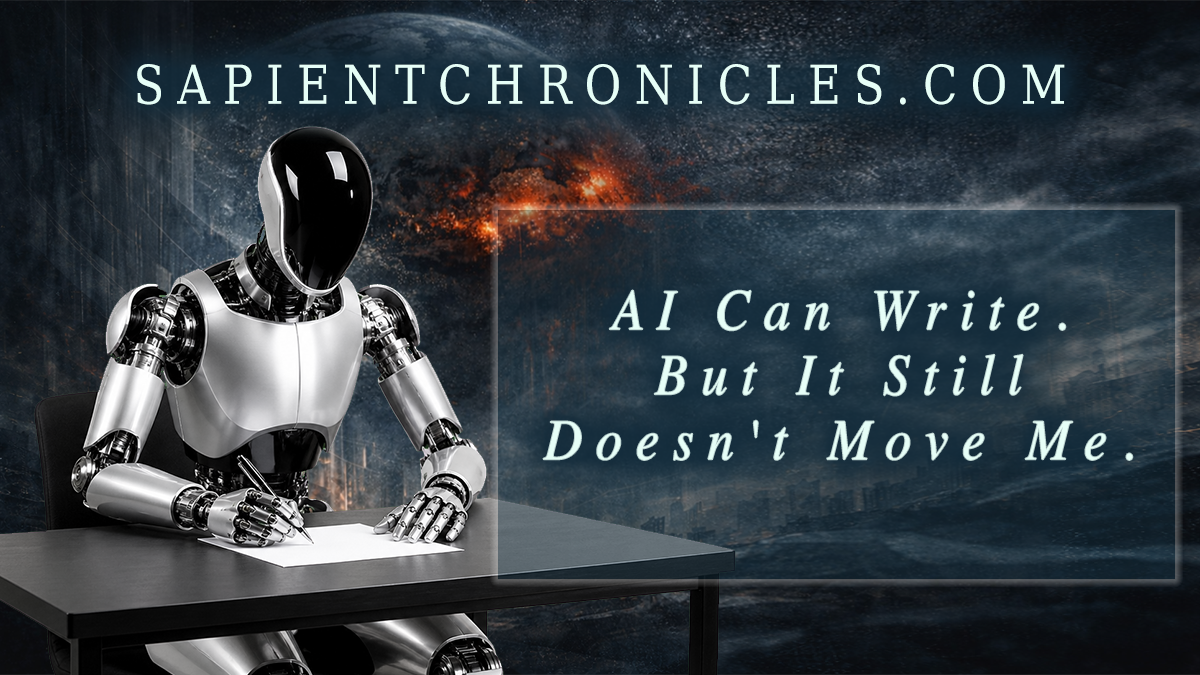
AI Might Have Better Technique Than Me. But It Still Doesn’t Move Me.
That’s the tension I feel every time I sit down to write.
There are entire platforms built around having AI write books for you. Quick. Clean. Ready to self-publish. Some people are making real money doing it. I’m not here to judge that. But it’s not what I do, and it’s not what I wanted for my novel.
My book is about AI. The irony is not lost on me. But AI did not create the story. It could not have. The story came from places inside me that a machine has never been, and I don’t mean that as a boast. I mean it as an observation.
The artist I work with uses AI tools to create visuals for my marketing. I’m completely fine with that. For certain things, AI is exactly the right tool. But when it comes to storytelling, that’s where I draw the line. At least for now. At least for me.
What AI Writing Is Missing
Right now, AI is technically impressive in ways that genuinely take my breath away. Even so, it lacks something deeper. It doesn’t bleed. It doesn’t wrestle. It doesn’t carry the weight of lived experience into the room with it. That absence shows up on the page whether the reader can name it or not.
AI stories can be clean. They can be clever. They can be structurally sound in ways that would make a writing professor weep with joy. But they don’t stay with you.
Real art does.
Whether it’s a painting, a film, a song, or a novel, we don’t love it because it was executed perfectly. We love it because it hit something inside us, something we couldn’t let go of, while it simultaneously refused to let go of us. Technique may get attention. It does not earn memory. Heart does.
That’s the missing ingredient in AI writing. At least today.
The Question I Can’t Stop Turning Over
What happens when AI closes that gap?
What happens when it can write, paint, perform, and create at a level that doesn’t just approximate human feeling but actually replicates it? Will we even be able to tell the difference? Will it matter if we can’t? And if a machine can produce something that moves you to tears, that keeps you up at night, that changes the way you see the world, does it matter how it got there?
I don’t have clean answers. But I have a direction my mind keeps moving toward, and I want to be honest about it even if I can’t fully defend it.
Made by a Creator, Made to Create
I believe human beings are creative because we were made by a Creator. That’s not a throwaway line for me. I mean it in the most foundational sense. The impulse to make things, to tell stories, to find meaning through art, isn’t just a survival mechanism or a cultural accident. It’s part of what we are at the deepest level. It’s image-bearing. It’s ontological. It’s baked into our nature, not just our behavior.
That belief raises an uncomfortable question.
If we are creative because of what we were made to be, what does it mean that we turned around and made something that creates? Did we pass something on? Can creativity be inherited the way certain traits move through a family line? Or is it more like a gift given specifically to us, something that belongs to the giver’s nature and can’t simply be transferred down the chain?
I want the answer to be simple. I want to say that what God imparted to humanity is ours alone, that a machine can recombine and retrieve and simulate but never truly create, that there is something irreducibly human about art that no amount of processing power can replicate.
I want that to be true.
What I’m Honest Enough to Admit
But I’m honest enough to admit I’m not certain it is.
What if creativity isn’t something imported into us intentionally from outside the natural order, but something that can be inherited, passed along, showing up in new forms we didn’t anticipate? What if the things we build eventually carry something forward that we didn’t mean to give them?
That question sits differently depending on where you stand spiritually. For someone with no faith framework, it might just be an interesting philosophical puzzle. For someone who believes, as I do, that human beings occupy a specific and irreplaceable place in creation, it’s a lot more personal than that.
I’m not ready to say AI will never cross that line. I’m also not ready to say it will. What I’m willing to say is that it hasn’t crossed it yet, and the reason it hasn’t is worth paying attention to.
The Stories That Wreck You
The stories that have wrecked me over the course of my life, the ones I still carry around decades later, all came from people who were paying a price to tell them. Tolkien writing through two world wars and the loss of nearly every friend he had. Card asking what we owe to children we’ve pushed past their limits. Artists who didn’t just construct something. They confessed something.
That confession is what moves people. That’s what stays.
Maybe one day a machine will confess something too. Maybe it will surprise all of us.
Until that day, I’ll keep writing from the places that hurt and the places that hope. Because that’s where the real stories live. And no matter what happens with the technology, I don’t think that will ever stop being true.
At least, that’s what I want to believe. And I’m willing to admit that wanting it doesn’t make it certain.
That tension, right there, is very human.
The best is yet to come!
Alan D.
Leave a Reply