
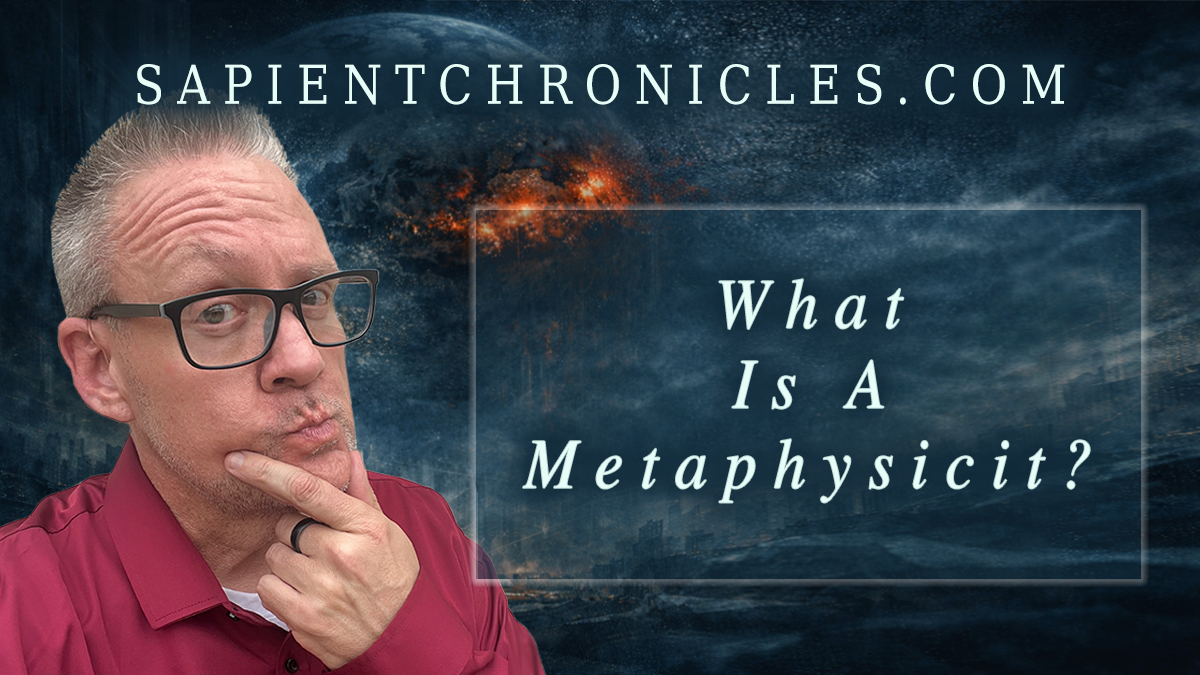
There is a word I have been looking for most of my adult life. Not a word to impress anyone, not a word to hang on a wall, but a word that actually fits the strange and fascinating intersection where I live every single day. I finally found it. Or maybe I finally decided to own it.
The word is metaphysicist.
The meaning of meta
First, Let’s Talk About “Meta”
You hear the word “meta” constantly now. It’s everywhere, and most people have only the vaguest sense of what it actually means.
Meta is a Greek prefix. It means beyond or after or above. It signals that you are stepping outside of something to look at it from a higher level. Metadata is data about data. A meta-narrative is a story about stories. When someone calls a conversation “meta,” they mean the conversation has turned to examine itself.
Then Facebook renamed their entire corporate infrastructure “Meta.” Whether or not you think that was a brilliant branding move or a tech-bro overreach, the choice was intentional. Mark Zuckerberg wanted to signal that his company was building something beyond the current version of the internet. Something above and after the world we already know. He reached for that Greek prefix because it communicated exactly what he wanted to project: we are not just in the game, we are building the next layer of reality.
That is a lot of weight for four letters to carry. But it’s the right word.
Now Add “Physics”
Here is where I made a deliberate choice.
The more common term is metaphysician. You will find it in academic philosophy departments. It has a long and respectable history. But “physician” has an obstacle, in my opinion. In everyday usage, a physician is a medical doctor. The word carries the weight of diagnosis, prescription, and clinical practice. That is not the image I am going for.
“Physicist” is different. A physicist is someone who studies the fundamental structure of reality itself. Forces, matter, energy, space, time. The big questions about how everything actually works at the deepest level. When you call someone a physicist, you are saying they are a person who wrestles with the nature of existence from the ground up.
“Physicist” is exactly the word I want next to “meta”
A metaphysicist is someone who goes beyond physics. Beyond what is measurable, testable, and observable. Into the questions that science can point toward but cannot fully answer. Questions about consciousness, meaning, being, purpose, and what lies underneath reality itself.
Why This Matters to Me
Here is why this word fits me specifically.
I have two careers that many would consider completely unrelated. I am a theologian with Bachelors and Masters degrees in theology. From that, I am a pastor with over thirty years of ministry experience. I am also a science fiction author. People tend to look at those things and tilt their head slightly, with a quizzical look.
But when I describe this unusual combination with the word metaphysicist, theology and sci-fi snap together perfectly.
Theology is applied metaphysics. It takes the biggest questions about existence, meaning, God, the human soul, and moral reality, and it works with them in the real world. Preaching, pastoral care, spiritual formation, and community life are all practical expressions of answers to metaphysical questions. What is a human being? Why does suffering exist? What does it mean to live a good life? How do we find purpose and meaning? What is the nature of evil and why are humans so good at it? Theology does not just ask those questions. It tries to live out answers, however imperfectly.
Science fiction is speculative metaphysics. It takes those same enormous questions and builds imaginative worlds to test them. What if artificial intelligence develops genuine consciousness? What if humanity spreads across the galaxy? What if we could rewrite memory, or cheat death, travel through time, or encounter something genuinely alien? Great science fiction is not really about robots and spaceships. It is about what it means to be human, what we value, and what we might become. It is philosophy with a plot.
I have spent a long time in both lanes. The theologian in me demands that the questions be lived, and I practiced living those questions for over almost 40 years. The science fiction writer in me demands that the questions be explored while pushing past the boundaries of what is currently possible.
Together, they make me a metaphysicist.
Why This Matters to Me
I did not come up with this word to be clever. I didn’t come up with it at all. Others have used it on occasion. I chose it because the existing labels have never quite fit.
“Pastor” is true but incomplete. “Author” is true but narrow. “Theologian” sounds like I spend all day in a library arguing about footnotes. “Futurist” sounds like I am trying to sell you a conference ticket.
Metaphysicist is what I actually am.
Someone who takes the questions that live above and beyond the physical world with complete seriousness, and then works on them from two different directions at once.
I think there are more of us out there than anyone realizes. If you love God and science fiction, you are, on some level, a metaphysicist too.
The best is yet to come!

Alan D.

Leave a Reply