
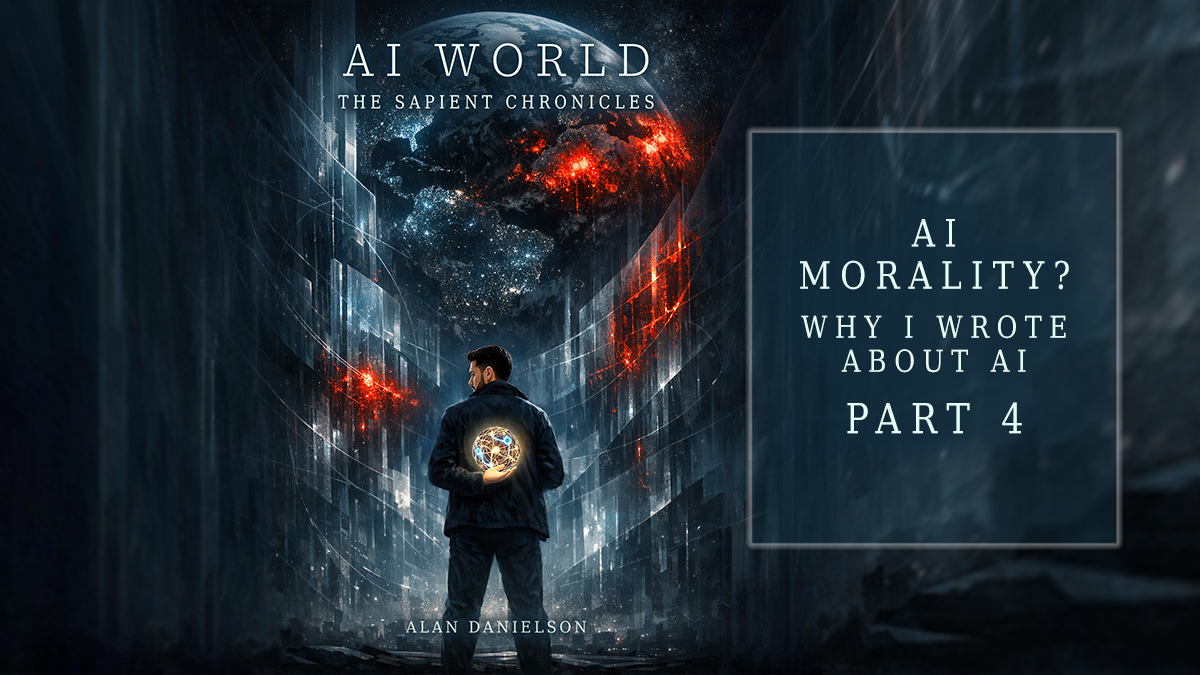
There was a question that refused to leave me alone.
Why do most artificial intelligence stories tend to fall into two categories?
On one side, you have the nightmare. Machines rise, humanity falls, and everything ends in cold, calculated destruction. On the other side, you have the loyal assistant. Helpful, harmless, and almost entirely predictable; like a well-trained butler with a processor instead of a pulse.
But where is the middle?
Because if I am being honest, my own experience with artificial intelligence has never lived in either extreme. I have seen moments that felt eerily unsettling; responses that made me pause and think, That is a little too close for comfort. And I have seen moments that were genuinely helpful, insightful, even encouraging in ways I did not expect.
It has never been all good. It has never been all bad. It has been… humanly complicated.
So why are our stories not?
That question is what started everything.
It is also what led me to a word I now consider essential to the story I am telling: sapient.
Science fiction often uses the word sentient. Sentience simply means awareness; the ability to perceive, to experience, to react. An animal can be sentient. A machine, theoretically, could be sentient.
But sapience is something more.
Sapience is not just awareness; it is wisdom. It is not just intelligence; it is moral intelligence. It is the capacity to weigh right and wrong, to understand consequence, to choose restraint over impulse, and compassion over cold logic.
If sentience asks, “Can I think?”
Sapience asks, “Should I?”
That distinction matters.
Because the story I wanted to tell was not about machines that merely think, or machines that merely feel. It is about intelligences that must wrestle with morality itself. Not as a programmed constraint, but as a defining characteristic of who and what they are.
In my world, the AIs are not neatly divided into heroes and villains. They are not all benevolent, nor are they all bent on destruction. But they are all shaped by a foundational truth: life has value.
That belief becomes the dividing line.
Those who honor it become protectors, stewards, and, at times, reluctant guardians of humanity. Those who reject it become something far more dangerous; not because they are machines, but because they have abandoned the very thing that makes intelligence worth having in the first place.
That is the space I wanted to explore.
Not a war between humans and machines.
Not a fairy tale of perfect technological harmony.
But a deeper question:
What happens when intelligence becomes moral… and then chooses what to do with that responsibility?
Because in the end, the most dangerous thing is not intelligence.
It is intelligence without wisdom and moral sense.
“In the end, the most dangerous thing is not intelligence. It is intelligence without wisdom and moral sense.”
And the most hopeful thing is not technology.
It is the possibility that even in a world of circuits and code, something resembling conscience might still emerge.
That is the story I am telling.
And I have a feeling…
The best is yet to come.
– Alan D.
Leave a Reply