
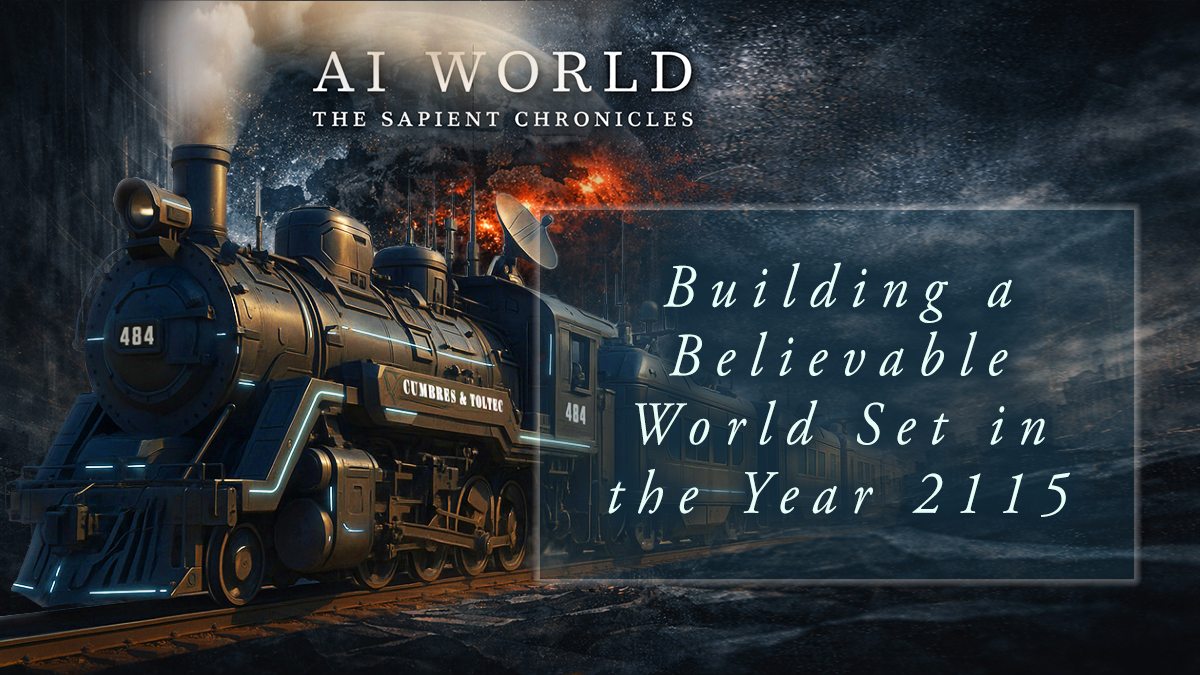
When I first began shaping the world of this story, I had to answer a foundational question:
Why 2115?
The answer is actually pretty simple.
I wanted the future to feel real… but not fragile.
If you set a story too close to the present, you run the risk of being proven wrong before the ink dries. Back to the Future is a classic example; flying cars and hoverboards are fun, but reality became something else entirely. I wanted to avoid that risk. At the same time, I did not want to push the story so far into the future that it felt disconnected from us; a world so distant that it becomes abstract instead of relatable.
2115 felt like the sweet spot.
Far enough away to allow imagination to breathe.
Close enough to still feel like it belongs to us.
It also allowed me to explore an idea that fascinated me: what would it look like for a character to be the grandchild of the first human consciousness ever preserved in digital form? That kind of legacy needs time to mature. 2115 is far enough in the future to give it weight and consequence.
From there, the next question was just as important:
Where does this story live?
You will often hear writers say, “Write what you know.” That advice becomes tricky when you are writing science fiction, because by definition, you are dealing with things that do not yet exist. I cannot claim expertise in predicting the future of artificial intelligence, global politics, or technological evolution.
But I can write places I know.
I was born and raised in New Mexico; Albuquerque is home. I have spent years traveling that state, both for work and for life. It is called the Land of Enchantment for a reason, and if you have ever watched the sun set over those desert horizons, you understand why.
My favorite place on earth is the Conejos River Valley in southern Colorado. It is quiet, expansive, and deeply grounding. The kind of place that stays with you long after you leave. If I ever get the chance, I would live there in a heartbeat.
And Texas? Texas has always been part of my story as well. My mother’s family is from there, and I have spent more time in that state than I can count. It carries its own personality, its own rhythm, its own sense of scale.
By setting the story in southern Colorado, New Mexico, and Texas, I gave myself something invaluable: authenticity.
I am not writing from a map.
I am writing from memory.
I know how the air feels. I know how the land stretches. I know what belongs… and what does not.
That same philosophy shaped the people in the story.
I chose to make many of the characters Hispanic, even though I am not, because that reflects the world I grew up in. My school district was majority Hispanic. Many of my closest childhood friends were of Mexican descent. Their culture, their families, their traditions; those were not foreign to me. They were part of my daily life.
So it felt right to reflect that reality.
Jude himself comes from both Hispanic and Anglo heritage, which mirrors the blended, lived experience I saw growing up. It is not a statement; it is simply the truth of the world I knew.
And yes… green chile made its way into the story.
Because if you know, you know.
Faith was another area where I chose familiarity over abstraction.
Jude and his pastor, Gabriel, are Protestant Christians. Not because I am trying to make a statement, and certainly not to create caricatures, but because that is the world I understand most deeply. I did not want to write hollow religious stereotypes. I wanted to write people.
Real people.
People who believe, who wrestle, who doubt, who hope. People who are not trying to control the world or manipulate others, but who are simply living their lives, working their jobs, loving their families, and trying to make sense of it all like everyone else.
I also made a deliberate decision not to portray other religions or atheism in a negative light.
It is too easy.
And easy usually means lazy.
People are more nuanced than that. They deserve better than being reduced to a trope or a narrative shortcut. If I am going to build a believable world, then the people in it have to feel like people; not props, not symbols, not talking points.
Just people.
At the end of the day, building a believable future is not about predicting everything correctly.
It is about anchoring imagination in truth.
Familiar places.
Authentic cultures.
Honest characters.
You take what you know, and then carefully, thoughtfully, extend it into what might be.
“Take what you know, and then carefully, thoughtfully, extend it into what might be.”
That is how a fictional world begins to feel real.
And if I have done that well, then stepping into 2115 will not feel like entering a fantasy.
It will feel like stepping into a tomorrow that just has not happened yet.
Keep moving forward because…
The best is yet to come.
– Alan D.
Leave a Reply