
Every writer is shaped by other writers.
That is not laziness. That is lineage.
We all read stories that leave fingerprints on us. We carry their rhythms, their courage, their imagination, and their questions. Sometimes they influence our prose. Sometimes they influence our structure. Sometimes they simply remind us what kind of honesty, wonder, or momentum a story can hold.
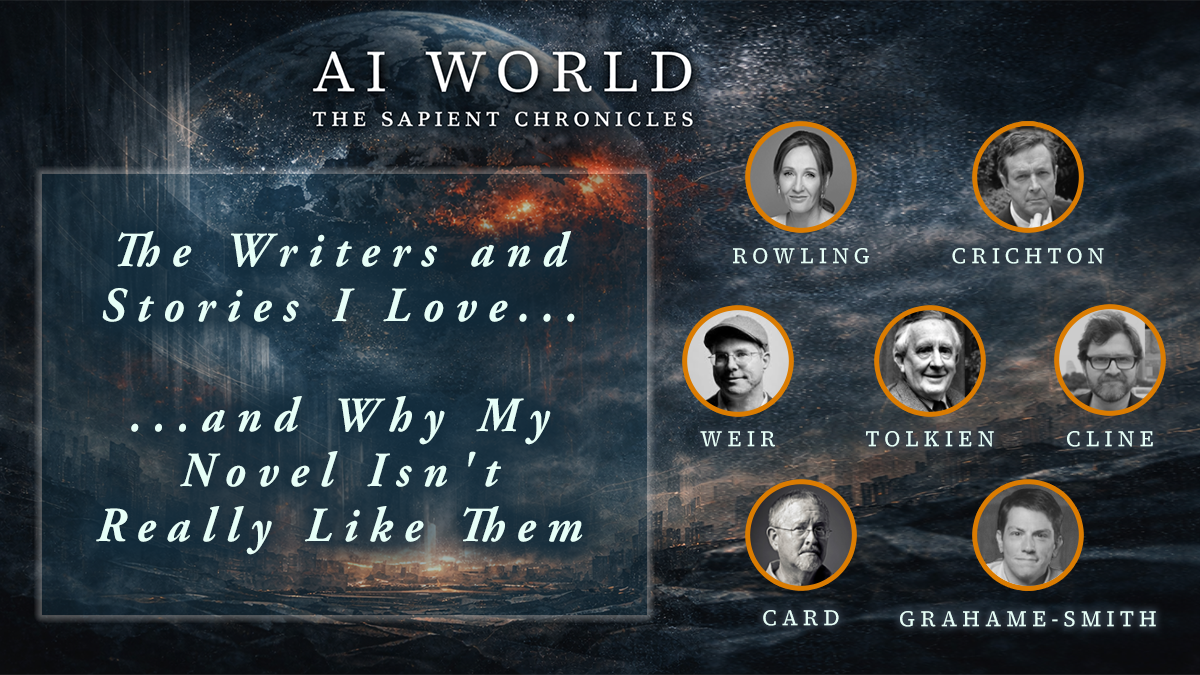
While I have a ton of favorite books, some of them recent, my top ten list is made up of books that have drawn me back multiple times. I’ve read all of the following books many times over.
- Ender’s Game (Orson Scott Card)
- The Lord of the Rings trilogy (J.R.R. Tolkien)
- The Martian (Andy Weir)
- Harry Potter (J.K. Rowling)
- Ender’s Shadow (Orson Scott Card)
- The Hobbit (J.R.R. Tolkien)
- Ready Player One (Ernest Cline)
- Abraham Lincoln: Vampire Hunter (Seth Grahame-Smith)
- Jurassic Park (Michael Crichton)
- Eaters of the Dead (Michael Crichton)
That is a bit of s strange mix.
It is a little literary, a little nerdy, a little adventurous, a little strange, and in one case, gloriously weird.
And yet, as much as I love these books, A.I. World: The Sapient Chronicles is not really like any of them.
Ender’s Game is my favorite novel of all time, and it may be the closest influence in one narrow respect. The chapter prelude material paired with prose narrative may remind some readers of the log-and-story interplay in that book. But beyond that, the similarities are limited. My novel is doing something very different in tone, theme, and structure. Still, I deeply admire the way Orson Scott Card fused intelligence, tension, moral weight, and emotional intimacy into something that never felt cold or clinical.
Then there is Tolkien. The Lord of the Rings trilogy and The Hobbit shaped my understanding of story architecture more than almost anything else I have ever read. Tolkien showed me that a story can feel large without losing its soul; that history, sacrifice, friendship, mystery, and moral gravity can all exist in the same world without becoming bloated or self-important. I do not write fantasy in Tolkien’s lane, and I am certainly not trying to build the next Middle-earth. But I learned from him that structure matters, that the long road matters, and that deep stakes are not the same thing as loud stakes.
Andy Weir is another favorite, especially The Martian. I love his clarity, his momentum, and his ability to make technical problem-solving feel urgent and fun. My writing is not nearly as breezy or engineering-driven as his. I am more reflective, more morally tangled, and less interested in science-as-puzzle-box than he is. But I admire how accessible he makes intelligence feel on the page.
The Harry Potter books belong on this list because they are a masterclass in readability, escalation, and long-form emotional investment. Rowling understood how to build attachment. She knew how to make readers want to live in a world, not just visit it. My work is obviously very different in genre, tone, and audience, but I have enormous respect for the sheer narrative grip of that series.
Ready Player One by Ernest Cline reminds me that fiction can be wildly imaginative and compulsively readable at the same time. My novel is not built on nostalgia, pop-culture references, or that kind of voice, but I respect his ability to generate delight and momentum.
Michael Crichton’s Jurassic Park and Eaters of the Dead represent two very different sides of what I admire in him. One shows his gift for making speculative science feel plausible, dangerous, and immediate. The other shows his remarkable ability to take historical or pseudo-historical material and make it feel muscular, atmospheric, and alive. I do not write pure techno-thrillers, and I am not trying to imitate Crichton’s style, but I love the way he respected the reader’s intelligence while still telling a gripping story.
And then there is Abraham Lincoln: Vampire Hunter by Seth Grahame-Smith, which remains one of my all time favorites. That book is proof that a concept can sound utterly ridiculous and still work brilliantly if the execution is confident enough. It has style, nerve, absurdity, and commitment. Best of all, it feels like it might just be true! The movie felt camply, but the novel does not. It’s a genius genre mash-up. My novel is not like it at all, but I admire any writer bold enough to make a reader say, “This should not work,” and then proceed to make it work anyway.
So where does that leave A.I. World: The Sapient Chronicles?
Honestly, somewhere in its own lane.
That may sound grandiose, but I do not mean it that way. I do not mean I have written something unprecedented or beyond comparison. I simply mean that influence is not the same thing as imitation. The books I love helped shape my instincts, but they did not hand me a template.
What I ended up writing is science fiction rooted in artificial intelligence, ethics, personhood, power, faith, and the human condition. It has technical elements, but it is not a Crichton-style techno-thriller. It asks spiritual questions, but it is not allegory. It has a few structural echoes that may remind some readers of Ender’s Game, but it is not military academy fiction. It carries moral and political weight, but it is not trying to be dense for the sake of sounding important. It has action, but it is not action-first.
It is, I hope, the kind of story that lingers. The kind that asks questions worth asking. The kind that trusts readers enough not to spoon-feed them easy answers.
Maybe that is what our favorite books do for us in the end. They do not tell us what to write. They teach us what kinds of stories are worth telling.
The best is yet to come.

Alan D.

Leave a Reply