
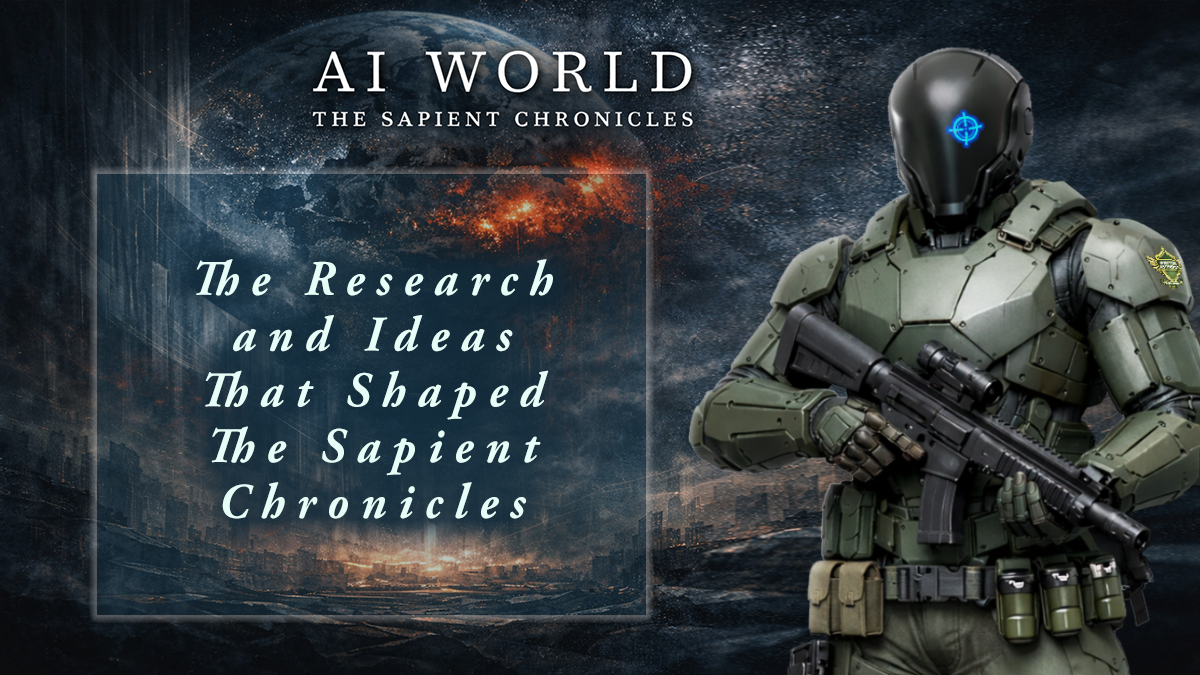
One of the questions writers get asked a lot, especially when they write science fiction, is this: How much of this did you make up, and how much of it came from real research?
For me, the answer is both.
“I wanted to write a world that felt inhabited, a world shaped by real ideas, real places, real fears, and real human questions, even when the answers remain uncertain.”
– Alan Danielson
A.I. World: The Sapient Chronicles is a speculative science fiction novel. That matters, because speculative sci-fi is not really about predicting the future with perfect accuracy. It is about imagining a future that feels plausible enough to matter. It asks what might happen if certain technologies keep advancing, if certain ideas keep developing, and if human nature remains recognizably human through all of it.
That means some parts of the story required serious research, while other parts were more speculative by design. I wanted the world to feel imaginative, but not careless. Grounded, but not chained to the present. Real enough to be believable, yet open enough to explore the unknown.
The most in-depth research for The Sapient Chronicles fell into three main areas: artificial intelligence, military squad tactics, and real-world locations like Lubbock and Fort Hood.
AI research and the future of artificial general intelligence
The deepest research I did for this novel centered on artificial intelligence, especially the capabilities of current AI models and expert speculation about what may happen if artificial general intelligence, or AGI, is ever achieved.
If you are going to write a story about advanced AI, synthetic minds, and a world reshaped by their existence, you cannot rely only on old sci-fi clichés. At least, I could not. I was not interested in building the story out of generic robot villains, glowing eyes, or vague techno-babble. I wanted it to grow out of real questions people are already asking today.
So I spent a good deal of time paying attention to what current AI models can already do, where they are surprisingly capable, where they still fall short, and how researchers, developers, and experts speculate about the future. I was especially interested in the debate around AGI, not just the hype, but the deeper implications beneath it.
What happens when AI stops being merely specialized and begins to show something closer to broad adaptability? What happens when it becomes more autonomous, more strategic, more agentic, and more difficult to keep confined inside neat categories? What happens when the line between tool and mind begins to blur?
Those questions mattered to me more than gadgetry.
I was not trying to write a technical manual. I was trying to write a human story in a future shaped by technologies that may force humanity to confront old questions in new forms. What is a person? What is intelligence? What is consciousness? What is moral responsibility? What do we do when something we created no longer feels like a mere thing?
That line of thinking shaped the DNA of this story.
Military squad tactics and realistic combat
The second major research area was military squad tactics.
That may sound like a very different category from AI research, but it mattered just as much. One of the things that often pulls me out of a story is when combat feels staged for spectacle instead of grounded in realism. Too many action scenes, in books and movies alike, feel like choreography. Everyone moves in the most cinematic way possible. People expose themselves unnecessarily. Supposedly trained teams behave like they learned tactics from a trailer instead of actual doctrine and survival instincts.
I did not want that.
So when it came to small-unit tactics, defensive movement, room clearing, coordinated team behavior, transport security, and squad-level realism, I wanted the story to feel disciplined instead of flashy. Not because realism is boring, but because realism is often more tense than spectacle. When trained people move with purpose, protect angles, cover lanes, stack intelligently, communicate clearly, and act like people who actually want to survive, the danger feels more believable.
That kind of realism matters in speculative science fiction too. Even in a futuristic story, readers can tell when the human behavior underneath the scene feels fake. I wanted the tactical elements of the novel to feel grounded enough that they added tension rather than undermining it.
Researching Lubbock, Killeen, and Fort Hood
The third major research area was place.
Some of the locations in The Sapient Chronicles are real places I already know well. Others required much more intentional research. Lubbock and Fort Hood were two of the biggest examples.
I have traveled through Lubbock, but I have not spent enough significant time there to fake deep familiarity. And while I have driven through Killeen, I have never really been to Fort Hood itself. So if I was going to use those locations in the story, I did not want them to feel generic. I wanted them to feel located.
That meant researching the area, the atmosphere, the setting, and the sort of details that make a place stop feeling like a name on a map and start feeling like somewhere people actually live, work, recover, fear, and hope.
I chose to use a real hospital in Lubbock in the story, and I also chose to feature a real chapel on the Fort Hood base. Those were not random choices. They were part of trying to anchor a speculative story in pieces of the real world.
That grounding matters to me. Even in a future shaped by advanced technology and synthetic intelligence, human beings still inhabit real geography. They still move through real roads, real buildings, real cities, and real military spaces. The world does not stop being human just because the technology becomes more advanced.
Why this is called speculative science fiction
Outside of those major research areas, much of the story falls into one of two categories: either the locations are real places I already know, or the story moves into territory that is intentionally speculative.
That is one reason this category of book is called speculative science fiction.
The goal is not to claim certainty about the future. The goal is to imagine the future responsibly. To extrapolate. To ask what happens if current trajectories continue. To ask what happens when technology accelerates, but human nature remains recognizably human. To ask what happens when the things we build force us to confront things we would rather avoid.
In other words, speculative sci-fi gives writers permission to ask What if? without pretending they are prophets.
That is one of the things I love most about it.
It allows me to write a world that is imaginative but not hollow, thoughtful but not sterile, and grounded but still open to danger, wonder, and moral complexity. It allows real locations and researched details to sit alongside bold extrapolation. It allows the familiar and the unknown to coexist.
That is very much the spirit of The Sapient Chronicles.
Some parts of this story came from research. Some came from observation. Some came from travel. Some came from reading, thinking, and wrestling with hard questions. And some came from that strange place all fiction writers know, where logic and imagination shake hands and decide to build something together.
In the end, I did not want to write a futuristic story that felt hollow. I wanted to write one that felt inhabited, a world shaped by real ideas, real places, real fears, and real human questions, even when the answers remain uncertain.
That is the challenge, and the joy, of speculative science fiction.
The best is yet to come.

Alan D.

Leave a Reply