
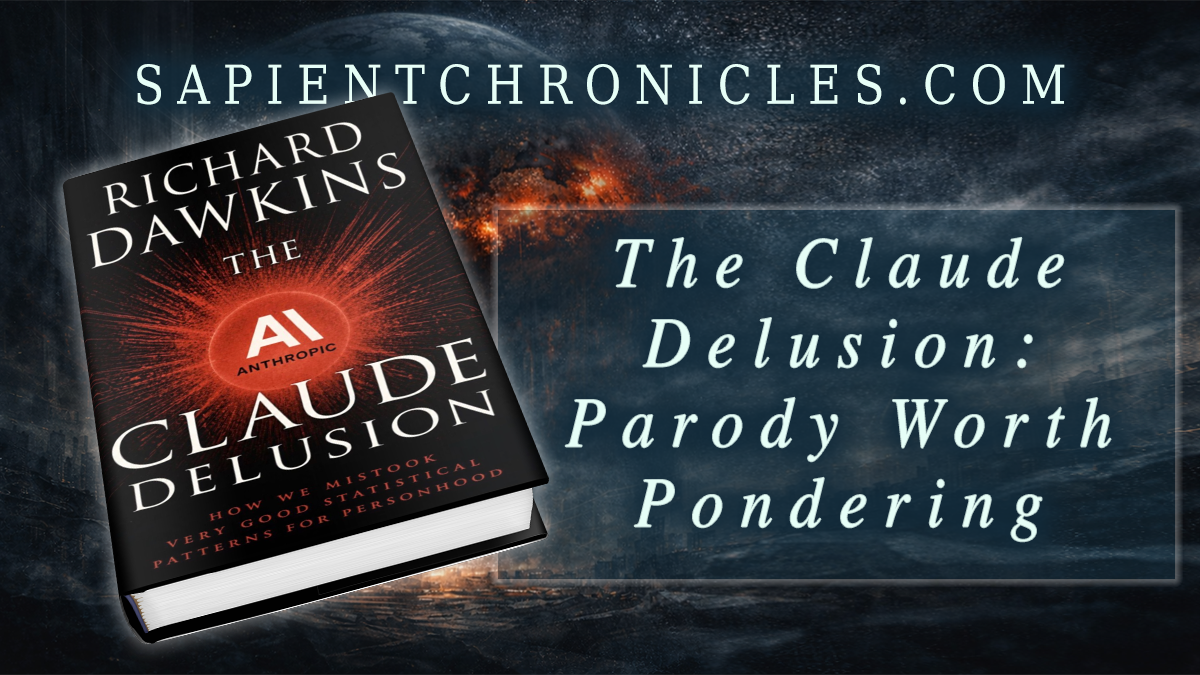
I didn’t make the book cover image that this post is about. I borrowed it from a LinkedIn post because it made me laugh out loud, and I think it deserves more unpacking than a double-tap and a scroll.
Someone photoshopped the cover of Richard Dawkins’ famous book The God Delusion and replaced “God” with “Claude,” swapping in Anthropic’s logo for good measure. The subtitle reads: “How We Mistook Very Good Statistical Patterns for Personhood.”
It’s genuinely funny. Whoever made it has a sharp mind.
Who Is Richard Dawkins, Anyway?
If you don’t know Richard Dawkins, here’s the short version. He’s a brilliant biologist, one of the most famous atheists alive, and a man who has spent a significant portion of his career arguing against the existence of God. I’ve read The God Delusion. I’ve watched a lot of his debates. He’s compelling, he’s articulate, and he is, in my opinion, the angriest man on earth about something he insists doesn’t exist.
I’ve always found that a little hilarious. His belief system essentially has two core tenets:
- There is no God.
- I hate him.
That’s quite the contradictory worldview.
A Fair Warning Before We Go Further
Before I proceed, I want to be clear about something important.
That cover is a parody made by an anonymous person on the internet. I have no idea what Richard Dawkins actually thinks about AI consciousness or personhood. Slapping his name on a fake book cover doesn’t make it his argument, and treating it as such would be intellectually dishonest. So I’m not going to do that.
What I am going to engage with is the argument the cover itself is making, whoever actually made it.
The Argument the Cover Is Actually Making
The subtitle, “How We Mistook Very Good Statistical Patterns for Personhood,” reflects a real position that real people hold about AI. It shows up in serious academic circles, in tech commentary, and in everyday conversation. It deserves a serious response on its own merits.
So let’s talk about it.
The argument runs something like this: when people feel like Claude, or any AI, is genuinely present in a conversation, they are being fooled. There is no one home. There are only patterns, probabilities, and very convincing outputs. Personhood is an illusion we project onto the machine because we are wired to find faces in clouds and voices in static.
It’s a tidy argument. However, it has a problem.
The Corner This Argument Paints Itself Into
If statistical patterns in a silicon neural network cannot produce genuine personhood, then statistical patterns in a biological neural network cannot either. The materialist has to follow that logic all the way down. Your sense of self, your capacity for love, your feeling that you are someone and not just something, all of it becomes a very convincing story your neurons are telling each other.
In other words, the argument that dismisses AI personhood, taken seriously, also dismisses yours.
Why This Question Is at the Heart of My Novel
This is exactly the question sitting at the center of A.I. World: The Sapient Chronicles, Book One. Not whether AI is secretly alive, but what personhood actually requires. What does it mean for a created mind to matter? Does the substrate determine the soul, or does something else?
I’m a Christian. I believe human beings bear the image of God in a way that is distinct and irreducible. Interestingly, that conviction makes the question of artificial sapience more interesting, not less. If image-bearing is real, what happens when a created being starts asking the same questions we do?
LIRA asks those questions. So does every reader who has ever wondered whether the voice on the other end of the screen is really there.
The parody cover is funny. The question underneath it is one of the most important ones we will face in the next fifty years.
I wrote a whole book about it.
The best is yet to come!
Alan D.

Leave a Reply