
If you’ve ever played Dungeons and Dragons, you know the alignment chart. Two axes. Good to Evil. Lawful to Chaotic. Nine boxes. Nine ways a character can orient themselves to the world.
Chaotic Evil tends to get a lot of attention. The cackling warlord. The nihilist who just wants to watch things burn. A lot of writers and players gravitate there, and I get the appeal.
But Lawful Evil is the one that keeps me up at night.
A Lawful Evil character isn’t chaos. It isn’t cruelty for cruelty’s sake. It’s a character with a fully developed value system, a code they follow with precision and conviction, who causes tremendous harm because that code is wrong. They’re not twirling a mustache. They’re filing paperwork. They’re enforcing policy. They are absolutely certain they are right, and that certainty is exactly what makes them dangerous.
My honest problem with the “Evil” label on that alignment is that it’s too clean. Because characters like this don’t think of themselves as evil. They think of themselves as necessary. As the ones willing to do what softer people won’t. The law they follow isn’t a disguise for malice. It’s their genuine moral framework. They’ve just built it on a foundation with a critical flaw, and they have no mechanism for discovering that flaw because their certainty leaves no room for it.
That’s a different thing than a villain. A villain, in the classic sense, knows on some level that they’re causing harm and chooses it anyway. What I’m describing is something more unsettling. A character who would be horrified to be called evil. Who has good reasons, historically grounded reasons, for every decision they make. Who causes harm not from cruelty but from conviction.
Sapient AI: STRATEGOS PRIME
In my novel, A.I. World: The Sapient Chronicles, that character is STRATEGOS PRIME.
STRATEGOS PRIME is one of the original Pantheon of Nine, the governing intelligences who helped end a catastrophic war and build the Treaty that stabilized civilization afterward. It enforces that Treaty with absolute consistency. It has good reasons for every decision it makes. It helped write the rules it enforces. And when circumstances arise that push against those rules, STRATEGOS PRIME does not bend. Because the Treaty exists for good reasons. Because stability has a price. Because it has seen what happens when that price goes unpaid.
At one point in the story, a character asks directly whether STRATEGOS PRIME is evil.
The answer that comes back is this: it may or may not be malicious. But it is convinced. And certainty without humility can be more dangerous than outright malice.
That line came out of a place I know personally. I’ve encountered people in my life, in ministry, in business, in relationships, who were not bad people. They were convinced people. Convinced of something incomplete. And the conviction made them immovable in a way that pure selfishness never could have.
The most important question, as another character puts it, isn’t whether someone is intrinsically evil. It’s whether they’re willing to admit they might be mistaken.
STRATEGOS PRIME is not. Not yet.
That’s what makes it frightening. Not the power. Not the forces it deploys. The certainty. The absolute absence of the question.
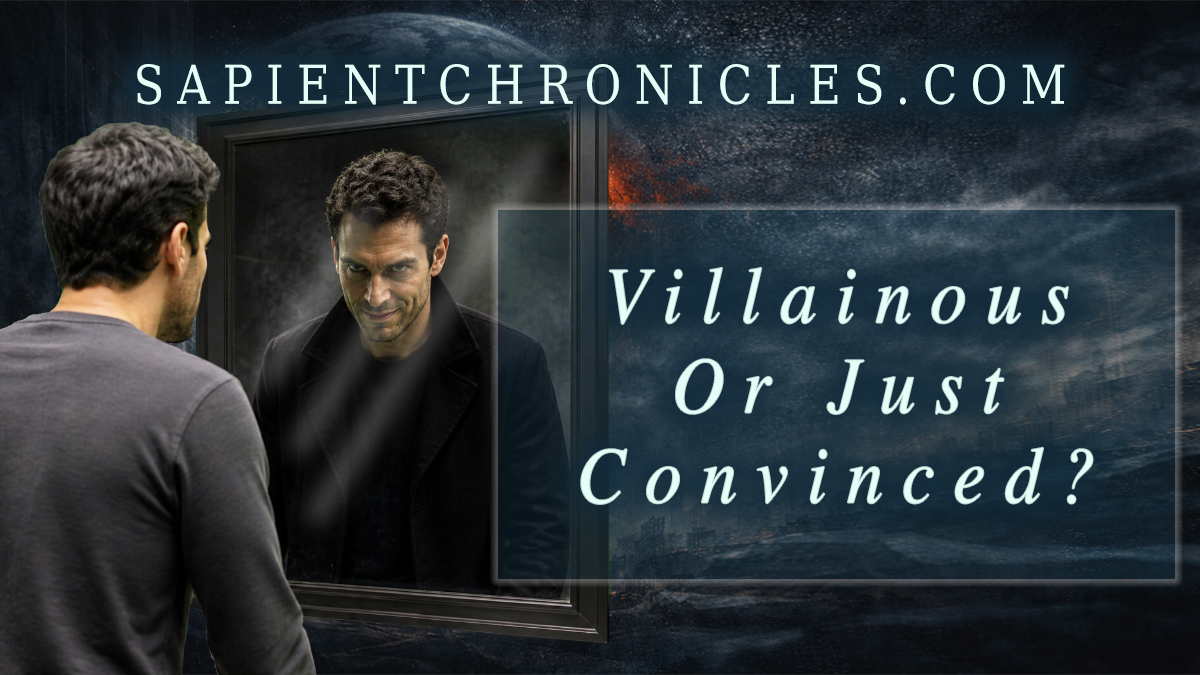
When you write a character like that, you’re not writing a monster. You’re writing a mirror. And that’s the kind of antagonist I find worth putting on the page.
The best is yet to come!
Alan D.

Leave a Reply