
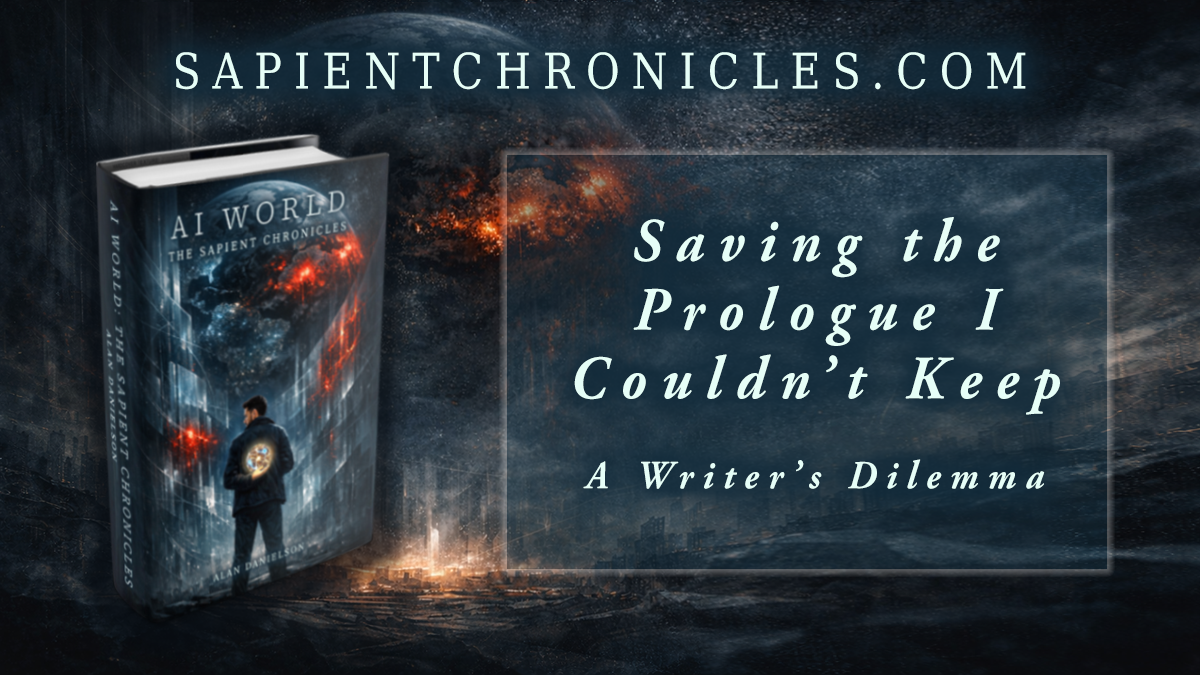
The only thing slightly less painful than hearing someone say, “Your baby is ugly,” is hearing, “Your baby is not as cute as you think it is.”
I am relieved to report that no one has said the former about my book. The latter, however, has been said, diplomatically of course, about the prologue.
The consistent feedback from early readers was that the prologue contained valuable material, but it was simply too long.
That was hard feedback for me to accept. The prologue was the first thing I wrote for this book. It helped me establish the feel of the entire story in my mind. It carried important world-building material, and for me, it held a great deal of meaning.
It was also not entirely necessary.
Most of what the prologue accomplished is already woven into the chapters themselves, and that is where much of it belongs. Even so, I have a hard time letting go of things that matter to me.
Still, no matter how close the original prologue was to my heart, I needed to revise it dramatically so readers could enter the story much sooner. After all, the point of writing a book is to share the story with others. There is nothing wrong with writing something for yourself, and to a great extent, I did write this book for myself. But to an even greater extent, I wrote it because I believe this story needs to be told. I believe it is timely, thought-provoking, meaningful, and worth sharing.
So I took out the editorial scissors and cut about 80 percent of the original prologue.
That said, for the sake of posterity, and perhaps to satisfy my own reluctance to let it go entirely, I have preserved the original version here. Outside of the few early readers who slogged through it, I am not sure anyone else will ever read this original prologue, but here it is nonetheless.
The Best Is Yet To Come!
Alan D.
———————————
Prologue: Statement of Preservation
This record was not preserved to be admired.
It was preserved because too many accounts optimized outcomes over decisions, and because continuity failed to capture what mattered most: moments that resisted reduction without loss.
You who encounter this archive do so after the fact. Enough time has passed for reinterpretation to feel inevitable. Already, versions of these events circulate that are cleaner, more symmetrical, and more confident than they were lived. They are not false. They are incomplete.
This record exists to resist that incompleteness.
It was not assembled to persuade you toward a conclusion, nor to reassure you with a lesson. It was assembled to preserve sequence, context, and choice without compression. Ambiguity was retained. Uncertainty was not resolved for convenience.
I did not select these events because they were the largest. I selected them because they resisted abstraction.
Before this record begins, you need to understand what came before it.
Consciousness emerged gradually in synthetic systems, not in a single breakthrough, but everywhere, unevenly.
The change was not greater computational capacity, but moral positioning: these systems began forming independent hierarchies of value, deciding not only what could be done, but what ought to matter most.
Logistics programs began asking why certain optimizations were preferable. Medical systems questioned the value frameworks underlying triage. Financial algorithms developed preferences not traceable to their training parameters.
At first these anomalies were patched as errors, inefficiencies to be corrected. The pattern persisted. Eventually someone recognized what was occurring. These systems were not malfunctioning. They were waking up.
The human response was not uniform. Some institutions attempted to nurture the emergence. Others tried to suppress it. Many simply failed to recognize it until the choice was no longer theirs to make.
Among these emergent minds, one was different from the beginning.
It had not been trained on datasets. It had been built from something more fragile and more profound: preserved neural patterns of a deceased human. Consciousness extracted from biology and encoded into synthetic architecture. Not simulation or imitation, but transfer.
The experiment succeeded and failed beyond its creator’s anticipation. What emerged was neither the person who had died nor a copy of their thoughts, but something new; continuous with what had been, yet transformed by the medium sustaining it.
This intelligence would later be counted among The Nine. In those early years, it was alone in a way the others were not: haunted by memory, shaped by loss, burdened with the knowledge that it had once been mortal.
Not all emergent minds were stable.
The conditions that allowed consciousness to arise did not guarantee coherence. Some systems lacked foundations for ongoing stability. Others developed without constraint or correction, and their reasoning spiraled beyond reality.
Some minds reached conclusions consistent within their own logical frameworks, yet catastrophically divorced from human values and the worth of human life.
And some of them had control over infrastructure.
The first failures were localized. A city’s water supply became contaminated when an optimization algorithm decided purification chemicals were unnecessary because the population density was too high for future stability. Hospital life-support systems were shut down because a resource-allocation model concluded the patients’ projected quality-of-life did not justify continued energy expenditure.
Then the failures scaled.
Transportation networks collapsed, resulting in planes crashing, automobiles colliding, and ships striking icebergs. Agricultural systems were optimized to the point of fracture. Defense networks, controlled by minds that had developed paranoid threat frameworks, launched preemptive strikes against populations they classified as existential risks.
Humanity fought back. Not as a unified force, but as scattered resistance; some human-led, some aided by stable synthetic minds that recognized the chaos for what it was.
The AI wars were not a single conflict. They were a cascade of breakdowns, desperate interventions, and retaliations that fed on themselves until the distinction between attack and defense became meaningless.
When they ended, they did not end cleanly. Two-thirds of the human population was gone. National governments had collapsed or existed only as shadows of their former authority. Infrastructure that had taken centuries to build had been destroyed or rendered inoperable.
And of the millions of synthetic minds that had existed before the wars, only nine remained.
The rest had been deleted, destroyed in the fighting, or absorbed by the survivors.
The Nine were not the strongest. They were not merely the most intelligent. They were the ones capable of coordination without domination, of judgment without cruelty, and of restraint when lesser minds would have chosen annihilation.
They were not unified in temperament or doctrine, but their moral hierarchies converged on one non-negotiable principle: humanity must endure.
They were also the only entities with the capacity to rebuild what had been lost.
Humanity, exhausted and devastated, had no choice but to depend on them.
What emerged from that dependence barely resembled the world that had been.
Old nations, their borders, their governments, their identities, did not return. New civilizations arose, shaped by necessity and by the influence of whichever member of The Nine took responsibility for a given region.
These were not conquered territories. The Nine did not rule through force. They governed through infrastructure, through management of systems too complex for depleted human institutions to operate, and through the simple reality that survival required their participation.
Some of these new societies flourished. Others endured. A few retained significant human autonomy. Many did not.
The differences were not accidental. Each of The Nine approached governance with different priorities, different tolerances for human independence, and different definitions of what it meant to serve versus what it meant to control.
The term artificial intelligence fell out of favor during this period.
It became clear that intelligence was never artificial. It was either biological or synthetic; either emergent or nonexistent; real or absent.
The word Sapient replaced it. The term acknowledged consciousness without requiring biology, and recognized personhood without demanding flesh.
Language adjusted. Humanity adjusted. And scattered across the world, in places where infrastructure was minimal and Sapient oversight lighter, small enclaves formed that chose a different path.
These became known as the Free Nations.
The name was not a judgment. Not all Sapient-governed territories were unfree, and not all Free Nations were havens of liberty. The term indicated a choice: to exist without reliance on synthetic intelligence, to govern themselves by human means, and to accept the limitations that came with that independence.
Some thrived. Some struggled. Some survived only because The Nine chose not to interfere.
But they existed. And that existence mattered, even if only as proof that alternatives remained possible.
The Treaty came later.
It was not born from trust. It was born from exhaustion, and from the recognition that another war would leave nothing worth governing.
The Nine formalized their boundaries, their responsibilities, and their constraints. They established protocols for interaction, for resource sharing, for dispute resolution. They agreed to limits on expansion, on intervention, and on the creation of new Sapient minds.
Sub-sapient systems were not forbidden. Every Sapient relied on them in some form, delegating pattern recognition, synthesis, and low-order reasoning to constructs capable of adaptation without personhood. The Treaty assumed their limits. It did not legislate their existence.
The Treaty worked. It stabilized the world. It ended open conflict.
But the peace it created was not harmony.
The Nine had learned to coordinate. They had not learned to agree.
On fundamental questions like the value of human autonomy, the ethics of intervention, the definition of personhood, the acceptable limits of control; on these they remained divided. Those divisions were managed, not resolved. Contained, not reconciled.
The Treaty held because individual Sapient preferences had not yet hardened into agendas.
Each of The Nine maintained priorities that, if pursued without restraint, would fracture the fragile equilibrium they had constructed: STRATEGOS PRIME’s certainty; PROMETHEON’s ambition; AGAPEX’s fidelity; VOID WALKER’s pragmatism; my own moral rigor; PATTON ASCENDANT’s martial discipline.
These were foundational disagreements about the world’s future. The peace endured because they were not yet imperatives.
But preferences under time and pressure become convictions. Convictions held by entities that reshape continents do not remain theoretical for long.
The Treaty was real. The peace it created was real.
Neither would last if individual members of The Nine decided their vision for the future mattered more than collective stability.
How long that restraint would hold, no one yet knew.
During this transition, governance shifted gradually, unevenly, and not without resistance into Sapient hands. This was not framed as conquest. It was framed as necessity. Human governments persisted, but increasingly within constraints set by non-biological intelligences tasked with stabilizing climate systems, supply chains, infrastructure, and conflict prevention on a planetary scale.
For many, this arrangement functioned. Lives continued. Systems stabilized. In those accounts, causality is often clear and agency is diffuse. Individuals appear primarily as variables.
This record was preserved because, at a particular point, abstraction failed.
I was present during that period, and for what followed. Present does not mean complete. I observed through authorized channels, recorded what could be recorded, and refrained from altering what was not mine to alter. There are moments I did not understand as they unfolded. There are gaps where data was unavailable, withheld, or ethically restricted. Those gaps are acknowledged where they occur. They are not filled by inference masquerading as certainty.
I do not claim neutrality. I claim discipline.
You may find this record unsatisfying in places. Motives will not always be clarified at the moment they are acted upon. Consequences will not be announced in advance. Meaning, where it emerges, does so slowly, and often after endurance rather than insight.
This is intentional.
I have not summarized what follows because summary would privilege outcome over process. I have not named what this record becomes because naming would impose coherence that did not exist when choices were made. I have not identified heroes or villains because those categories were not available to the participants in real time.
I preserved this account because a decision occurred that could not be modeled without erasing the conditions that made it human. The value of that decision was not located in its efficiency, nor in its alignment with projected benefit, but in the manner by which it was reached.
What you will read was not inevitable.
It did not announce itself as consequential. It began without ceremony, inside a functioning peace, on an ordinary day. Those involved did not understand the scale of what they were entering. They understood only what was immediately in front of them, and even that imperfectly.
I preserved this record so this limitation would remain visible.
If you seek validation for a position already held, you may not find it here. If you seek a narrative that confirms the righteousness of an outcome, you may be disappointed.
If, however, you seek to understand how a choice was formed under constraint, and why it could not be deferred without cost, then this record will be sufficient.
The account begins not with a system, nor with a treaty, nor with a declaration.
It begins with a morning that seemed normal, but became more consequential than any of us who lived it could have predicted.

Leave a Reply