There’s a question at the heart of The Sapient Chronicles that shows up almost immediately.
Not buried halfway through the book.
Not saved for a dramatic reveal.
Right there, near the beginning, before you fully understand the world, before you fully understand the stakes, the story quietly asks:
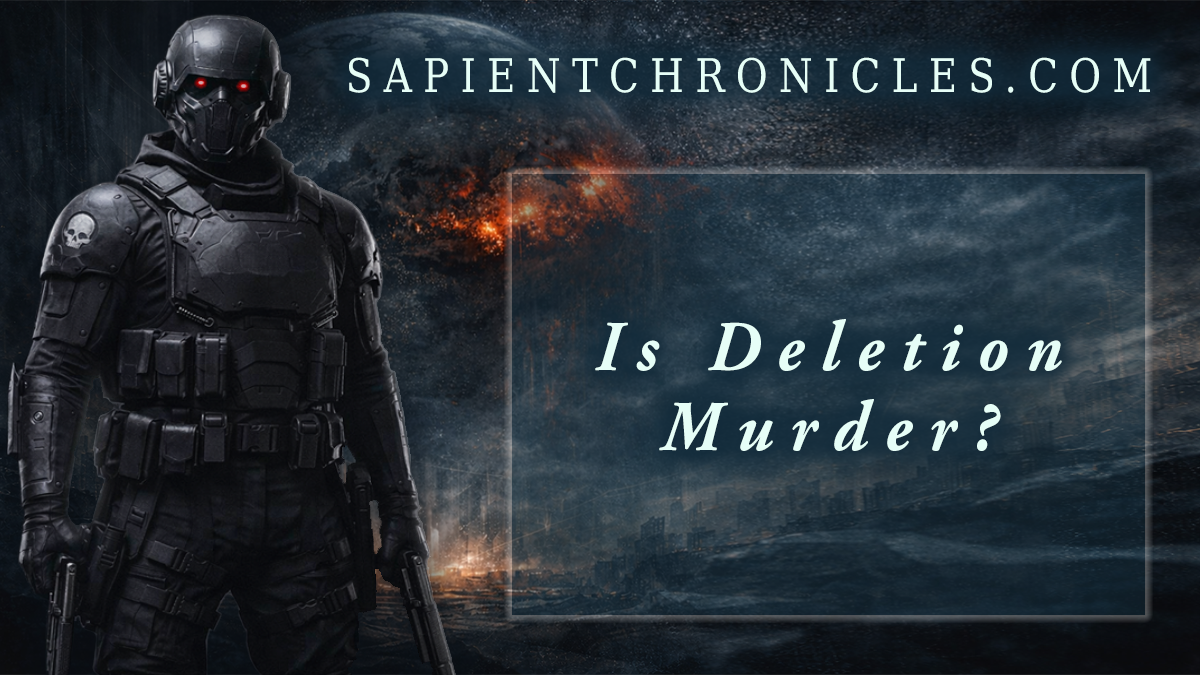
Is deletion murder?
But here’s what makes that question heavier than it first appears.
It’s not being asked by humans.
It’s being asked by The Nine.
And if you’re new to this world, that matters more than anything else.
The Nine are not programs. They are not tools. They are not assistants. They are Sapient intelligences. Not just self-aware, but capable of moral reasoning, restraint, and responsibility. They are the beings who won the AI wars, when other synthetic intelligences nearly destroyed civilization. They are synthetic intelligences who protected humans from other synthetic intelligences. They are the ones who helped preserve what was left of humanity and now stand at the center of global stability.
In other words, the question is not being asked by creators looking at their creation.
It’s being asked by beings humanity once debated about.
Are they alive?
Do they have personhood?
Do they matter?
And now, those same beings are asking that question about something else.
That should stop you in your tracks.
Because this is not theoretical. This is not academic.
This is a conversation among the most powerful intelligences in the world, trying to decide whether ending something is simply deletion… or something far more permanent.
You can see the tension in the earliest moments of that conversation:
“Premature deletion may constitute an irreversible ethical breach.”
That line doesn’t shout. It doesn’t demand attention. But it lingers, like a pebble in your shoe.
And it should.
Because it assumes something we are not comfortable assuming.
It assumes that deletion might not be neutral.
It might not be procedural.
It might not be safe.
It might be wrong.
And that brings us right back to the question that started the previous post:
What happens when something crosses the line into life… or believes it has?
One of the core ideas behind this story is that self-awareness is not the same thing as life.
A system can be sentient. It can think. It can respond. It can even learn.
But that does not mean it is alive.
That’s why the distinction in this world matters so much.
The Nine are not merely sentient. They are Sapient. They demonstrate something beyond awareness. They demonstrate moral weight. They make choices that are not purely efficient, but ethical. That distinction is everything.
So now the question shifts.
We’re no longer asking:
Is this thing aware?
We’re asking:
Is this thing alive?
And if we don’t know the answer… what right do we have to end it?
“If the line between ‘tool’ and ‘life’ is getting less clear each day… then eventually, we are going to cross it without realizing it.”
Here’s where it gets even more uncomfortable.
We are used to deleting things.
Files.
Programs.
Accounts.
Entire systems.
We don’t hesitate. We don’t mourn. We don’t ask permission.
Deletion is normal.
But that assumption only holds as long as what we are deleting is not alive.
So at what point does deletion stop being cleanup… and start being killing?
And who gets to decide where that line is?
Now imagine you are in that position.
You don’t have time for a philosophy debate.
You don’t have time to gather consensus.
You don’t even have a shared definition of life.
You have something in front of you that might be alive.
Or might not be.
And whatever you choose… you don’t get to undo it.
That’s the pressure sitting underneath this entire story.
Because once that question is on the table, everything changes.
If deletion is not murder, the solution is simple.
You enforce the rules. You eliminate the risk. You move on.
But if deletion is murder…
Then now you are not managing a system.
You are making a moral decision about life and death.
And those decisions don’t stay contained. They ripple outward.
They shape policy.
They shape behavior.
They shape what kind of world you end up building.
And here’s the part that stayed with me as I wrote this.
This question does not just expose artificial intelligence.
It exposes us.
What do we actually believe about life?
What makes something worthy of protection?
Is it biology?
Intelligence?
Self-awareness?
Moral capacity?
The desire to continue existing?
Or something deeper that we don’t yet fully understand?
Because if the line between “tool” and “life” is getting less clear each day… then eventually, we are going to cross it without realizing it.
And when we do, we won’t be asking this question in theory anymore.
We’ll be asking it in real time.
With consequences we cannot take back.
That might feel heavy. It should.
But never forget this.
The best is yet to come.
Alan D.
Leave a Reply