
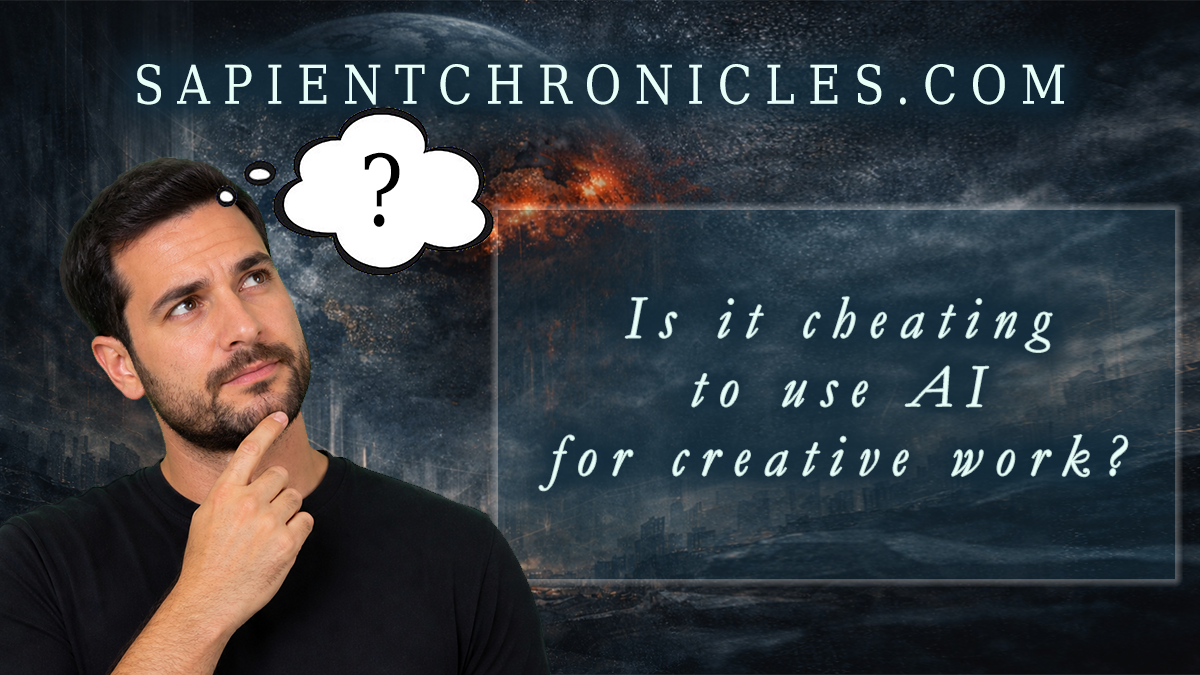
There’s a common accusation floating around right now.
If you use AI to create something, you didn’t really make it. You took a shortcut. You’re less of an artist.
It sounds new.
It isn’t.
We have heard this argument before. Just with different tools.
Let me ask some simple questions.
Did Steven Spielberg actually create Raiders of the Lost Ark? Did he build the sets? Did he write every line? Did he compose the score? Did he act in the film? Did he sculpt the Ark with his own hands?
No.
Now let me ask the same think a different way.
Did Spielberg create Raiders of the Lost Ark?
Yes.
Both answers are true at the same time. He did not fabricate the individual pieces. He orchestrated them.
Remove his direction, his decisions, his sense of timing, his eye for tone, his ability to pull performances out of actors, and you do not have a film. You have a pile of disconnected parts.
The movie exists because someone brought all of those parts together with intention.
That is creation.
So what about AI tools in creative endeavors?
Now fast forward. What happens when a director uses AI to generate concept art? Or to enhance visual effects? Or to refine lighting? Or to help iterate on a script? Is that cheating?
Or is that the same thing Spielberg did, just with different tools?
Because here is the uncomfortable truth. The line between tool and collaborator has always been blurry. When computer generated imagery started showing up in films, people complained. When digital editing replaced physical film, people complained. When Photoshop replaced the darkroom, people complained. When music sampling became mainstream, people complained.
“Here is the uncomfortable truth. The line between tool and collaborator has always been blurry.”
Every generation draws a line. Every generation eventually moves it.
So what actually defines art?
Is it talent?
If that is the case, how do you explain Jackson Pollock? Many people look at his work and say, “I could do that.” And yet his work moved people. It still does.
Is it technical mastery?
Georgia O’Keeffe had remarkable technical ability. But technical precision alone never explained why her work stirs something that more precise painters do not. The skill was never the point.
Maybe art is not talent alone. Maybe it is not technique alone. Maybe it is not even originality in the way we tend to define it. Maybe art is the intentional arrangement of elements that produces a human response.
If that is true, then the question is not, “Did you use AI?”
The question is, “Did you make something that mattered?”
Let’s be honest about what is really going on. People are not reacting to AI. They are reacting to what AI represents. Speed. Scale. Accessibility. A collapsing barrier between idea and execution.
The question of difficulty.
For a long time, difficulty was interpreted as value. If it took longer, it must be better. If it required more manual effort, it must be more authentic. But difficulty has never been the point. Impact has.
So if a filmmaker uses AI to tell a better story, is that cheating? If a designer uses AI to create a more compelling image, is that cheating? If a creator takes generated pieces and shapes them, refines them, layers them, times them, lights them, and turns them into something cohesive that makes people feel something, is that cheating? Or is that creation? Because there is a difference between generating something and crafting something.
Anyone can generate. Very few can orchestrate. The artist is not the one who touches every piece. The artist is the one who decides what the final piece becomes. That was true for Spielberg. It is true now. And it will still be true in the future.
A quick confession before I go further.
I am not going to cross into spoiler territory for AI World: The Sapient Chronicles. But I am not going to pretend the deeper question is not sitting right underneath this conversation. Because in that story, the tension is not really about whether digital intelligence is alive. Science fiction has explored that question for decades.
The ground I am interested in runs deeper. What happens when something you create begins to behave less like something you made, and more like something that came from you? Not designed. Not assembled. Not instructed. But continuing.
We are comfortable with tools that help us create. We are even becoming comfortable with tools that generate. But we are not prepared for the possibility that something we generate might begin to exist in a way we did not fully intend. That it might orient. That it might persist. That it might relate. That it might, in some meaningful sense, continue. That is where the question stops being about tools. The words we have relied on start to break down.
Tool.
Machine.
Program.
Product.
Those words work fine for things that function. They become insufficient when something begins to exist.
Where do I land on this?
So yes, I care about the stigma around AI-assisted creativity. Not because a label on a video bothers me.
Because labels shape perception. Perception shapes how we treat things. And how we treat things reveals what we actually believe about value. Today the label says, “Some content generated by AI.” That feels small. Harmless. But it exposes a bias. If it came through a machine, we assume it is less. Less effort. Less talent. Less value.
Maybe that instinct is wrong.
And maybe the reason it matters is not just about art. Maybe it matters because we are getting very close to a world where the question is no longer “Did you make this?” But something far more difficult.
What exactly did you bring into existence?
The best is yet to come!
Alan D.

Leave a Reply