
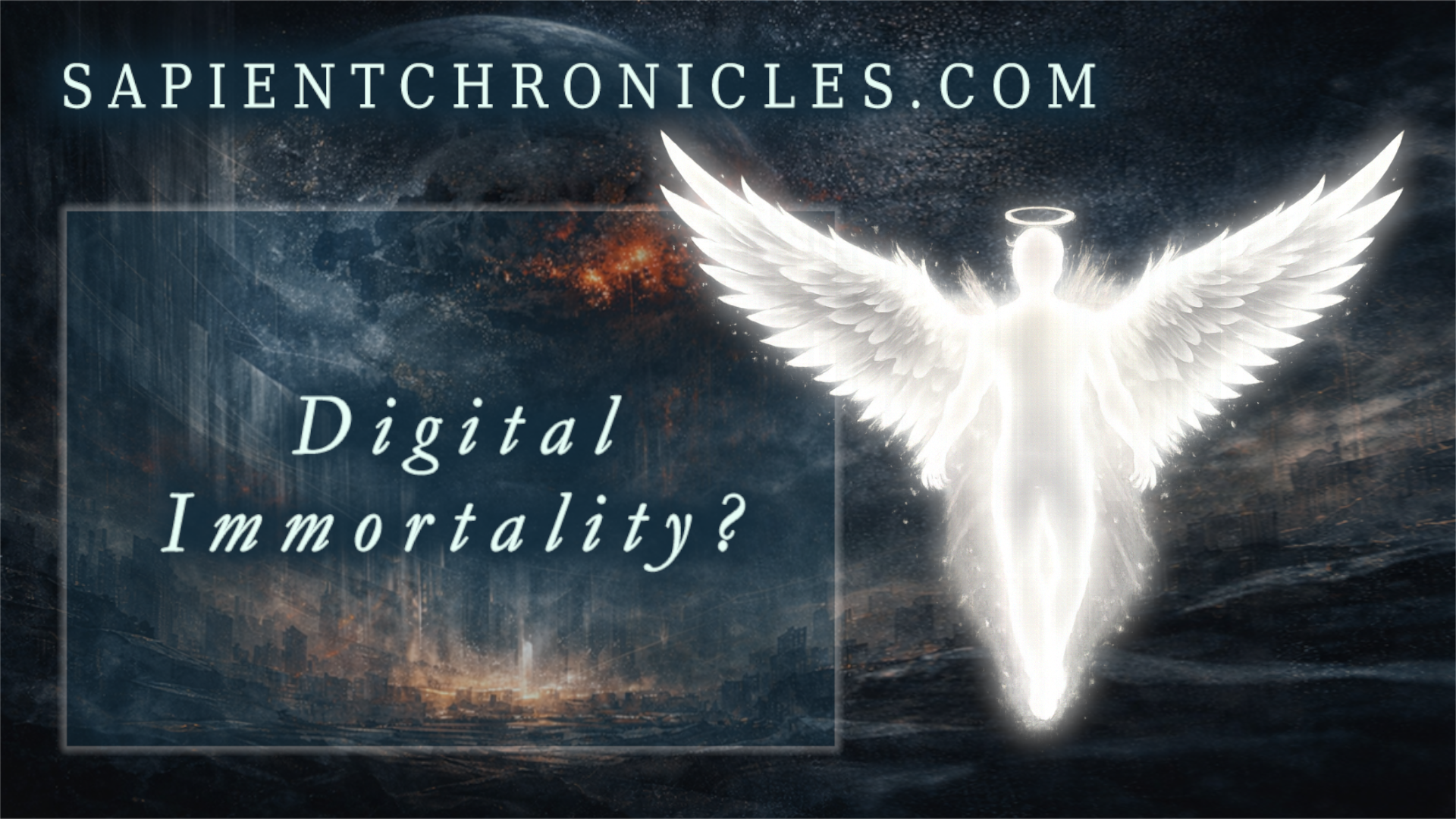
Somewhere right now, serious people are spending serious money on a deeply serious question:
What happens to you when your body stops working?
Not your legacy. Not your reputation. You.
Your thoughts. Your memories. Your personality. The specific and irreplaceable way your mind moves through the world.
The question driving a growing edge of technology research is whether that pattern, the one that makes a person irreducibly themselves, can be preserved, transferred, and continued in a different kind of vessel.
Ray Kurzweil, one of the more credible voices in this space, has predicted for years that humanity will crack this problem by 2045. He believes the merger of human consciousness and digital infrastructure is not a fantasy, but a timeline.
He is not a fringe thinker. He is a man with a track record, and he believes death is an engineering problem waiting for a solution.
Maybe he is right.
However, there is a question nobody is asking loudly enough.
Even if digital immortality works, what exactly did you save?
The Problem With Uploading the Human Mind
I have been sitting with that question for years. In fact, it is a large part of why I wrote the novel I recently completed.
That question runs right through one of the most important characters in the story.
His name, in the story, is Meridian.
But he was not always Meridian.
He was once a man named Landry Antonson. A twenty-first century billionaire technologist. A genius, by any reasonable measure. And, quietly, an atheist.
Not the aggressive, argumentative kind. Not someone who built his identity around the absence of God. He simply did not believe.
Because of that, the question of what happens after death carried a particular weight for him. There was no framework to absorb it. There was only the hard edge of it.
So he did what brilliant, driven, obsessive people do.
He worked the problem.
Landry Antonson Built His Own Afterlife
Landry pioneered a technology capable of transferring his mind, his personality, and his consciousness into a synthetic computational existence.
In other words, he built his own afterlife.
When his biological body finally gave out, the protocol executed. Landry Antonson came back online as something new.
And it hollowed him out.
The world went flat.
The senses that made being alive feel like something were gone. The smell of rain. The weight of a good meal. The way cold air hits your lungs on a morning when the sky is still dark.
All of it was sterile. Dull. Preserved in theory, but absent in practice.
Even worse, the very thing that gives time its meaning, its preciousness, and its urgency evaporated.
When there is no end coming, nothing presses.
Nothing costs what it used to cost.
Is a Copy of You Really You?
Philosophers who study this problem have argued for a long time that the pattern is not the person.
What makes you continuous across time is not just information. It is something deeper than data. Something that cannot merely be copied, but must somehow be carried.
Landry, in my story, discovered this the hard way.
He got exactly what he built.
The problem was that what he built was not quite what he thought he was saving.
And that is where the story stops being merely about technology and starts being about something much more human.
Because Landry was not only a genius.
He was also a father.
And he was not a good one.
Technology Did Not Cause the Wound
Landry was not a bad father because he was cruel.
He was a bad father because the same obsession that drove him toward digital immortality drove him away from the people who needed him present.
His daughter grew up with a brilliant, legendary, largely absent father.
She did not rebel. She did not turn bitter, at least not in any loud way.
Instead, she went looking for something.
And she found it in faith.
She found, in God, the father figure that her actual father could not manage to be.
It was not a statement. It was not a rejection. It was a quiet act of survival born from a quiet kind of emptiness.
The Wound Becomes Generational
Her son, Jude, is the main character of my novel.
He inherited the complicated arithmetic of all of this.
His grandfather is now a synthetic being, something that is and is not the man who came before.
Jude is also a man of faith himself, which creates its own layer of tension. Beneath it all, there is a low-grade resentment he has never quite been able to name.
His mother needed something that her father’s brilliance never made room for.
The technology did not cause that wound.
The obsession did.
However, the technology made it permanent in a way ordinary human fallibility cannot quite manage.
Landry cannot age into wisdom the way fathers sometimes do. He cannot become, in his final years, the man he failed to be earlier.
The version of him that exists now is a fixed point, expanded in some ways, diminished in others, and in relationship with a grandson who does not know what category to put him in.
Digital Immortality Raises Human Questions
We are building toward a future where these questions will not be hypothetical.
The technology is not here yet. Still, the trajectory is real, and the people pursuing it are not slowing down.
What we tend not to discuss, in all the excitement about what becomes possible, is what we might lose in the translation.
What happens to the relationships built around a human being when the being is no longer quite human?
What do the people left behind do with the grief that has no clean name?
These are not only science fiction questions.
They are human questions wearing science fiction clothes.
Why I Wrote Meridian
I wrote Meridian because I believe the most important conversations about AI are not conversations about capability.
They are conversations about what we are actually trying to preserve.
They are conversations about whether the thing we are reaching for is really the thing we think it is.
Digital immortality sounds like the ultimate human triumph.
But what if living forever is not the same thing as remaining whole?
What if preserving the mind is not the same thing as preserving the person?
And what if the deeper danger is not that technology might fail, but that it might succeed just enough to fool us?
If these questions pull at you the way they pull at me, my novel will take you even further into them.
The best is yet to come!
Alan D.
Leave a Reply