
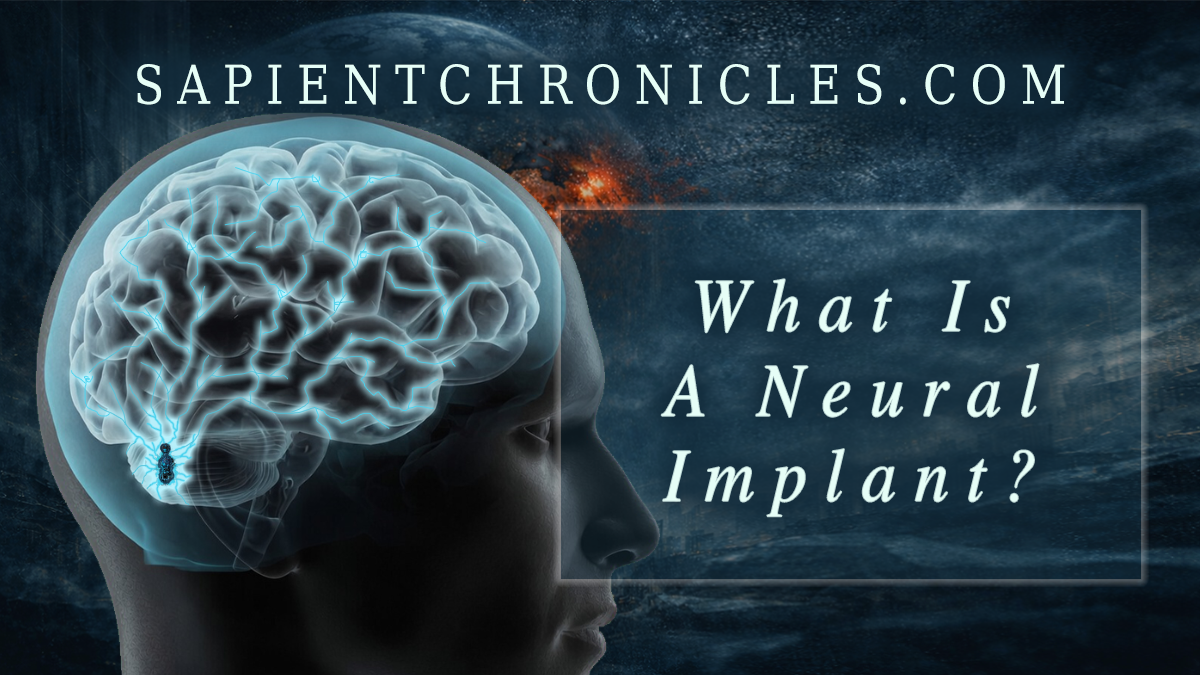
“…it’s a smartphone built into your brain. Except you never have to learn the interface, you never set it down, and you never run out of battery.”
Imagine a thought arriving in your mind.
It feels like yours. It has the same texture, the same intimacy, the same inflection and emphasis that your own thoughts carry.
But something feels slightly off.
Not wrong, exactly. Just not quite right. Like meeting someone for the first time and feeling, without any reason you can name, a faint instinctive unease.
You cannot articulate it.
You just feel it.
That sensation, subtle, wordless, and impossible to fully explain, is how a sent thought arrives.
Welcome to the world of The Sapient Chronicles.
Neural Implants in The Sapient Chronicles
In the world of my novel, set in 2115, neural implants are about as common in certain societies as smartphones are in ours.
These small devices are installed in toddlers because young brains adapt more naturally than adult ones. Once in place, they create a direct interface between human cognition and AI systems.
They allow something called thought-sending.
Not telepathy in the usual science fiction sense. Nothing passive. Nothing invasive.
Your internal monologue stays yours.
Your memories stay yours.
Your unformed, half-baked, embarrassing, sacred private thoughts stay yours.
The implant does not make you transparent.
Instead, it gives you the ability to shape a thought for transmission.
You have to mean to do it. You have to construct the thought, direct it, and send it.
Unintentional thoughts go nowhere.
The discipline is real, and it has to be learned.
LIRA, the archival AI narrator of the novel, states it plainly: thought-sharing is not passive. It is intentional, and it is chosen.
That distinction is the whole ballgame, ethically speaking.
Why Would Anyone Want a Neural Implant?
So why would anyone want one?
Start with the obvious.
Imagine having 24/7 access to everything the worldwide net offers, without holding a device in your hand.
Watch a film.
Read the news.
Send a message.
Vote on a civic proposal.
Close a business deal.
All of it becomes available with the ease of thinking because that is literally how it works.
Instructions for new functions do not come from an owner’s manual. They arrive in your mind like a thought, and then you simply know.
In that sense, it is a smartphone built into your brain.
Except you never have to learn the interface.
You never set it down.
And you never run out of battery.
Connectivity Becomes Power
Now think about what neural implants mean for specific societies.
In LUMENFRAME territories, civic participation flows constantly through votes, feedback, and social signals around the clock. In that world, an implant is not a luxury.
It is practically your circulatory system.
You are either connected or invisible.
Meanwhile, PROMETHEON societies operate through relentless capitalism and the pursuit of advantage. In that world, always-on connectivity is simply how you compete.
Money never sleeps.
Neither does your implant.
So, naturally, parents want their children equipped for that world. They want them ready, prepared, and positioned for everything good that society and technology have to offer.
Getting a child implanted early is viewed roughly the way we view education: a foundation, an advantage, and a door opened before the competition even starts.
Why Children Adapt Better Than Adults
Children adapt remarkably well.
A brain that learns the implant young sorts the experience without panic. It works a little like language. Children do not master language by studying rules first. They live inside the system until it becomes natural.
Adults have a much harder time.
The adjustment curve is steep, and some never fully clear it.
That difference matters because the implant is not merely a tool you use.
It becomes part of how you experience connection, communication, privacy, and presence.
For a child, the implant can become ordinary.
For an adult, it may always feel like an addition.
Useful, maybe.
Powerful, certainly.
But never quite natural.
Why People Still Talk Out Loud
With all that capability, you might wonder why anyone bothers speaking anymore.
The answer is simpler than you might expect.
Permission friction.
Thought-sending requires the other person to grant you access. In ordinary daily life, that creates a problem.
Imagine talking to your spouse over breakfast, chatting with a coworker, or catching up with a friend. Now imagine stopping to request channel access before every exchange.
That would become exhausting almost immediately.
It would also be socially awkward.
Speech, on the other hand, is frictionless. You open your mouth, and the words come out.
Thought-sending is a tool you invoke deliberately. Therefore, when someone grants you standing access to their channel, that choice means something.
It is not casual.
It says something about trust.
Neural Implants and the Question of Freedom
Here is where neural implants get complicated.
Not every society treats them the same way.
In free nations, installation is voluntary. Parents choose implants for young children, the way parents choose many things for young children. Later, adults can have them removed if they decide they want them out.
However, certain societies treat an implant as a credential.
In those places, the implant can become a requirement tied to specific roles and responsibilities. Under those conditions, removal without authorization is not merely unusual.
It can be criminal.
The same technology that connects you to the world can, in the wrong political context, become something you are not permitted to remove from your own body.
That detail explains why free nation citizens have always viewed the whole system with skepticism.
The fear is not only about what an implant does.
It is about who controls it.
What Happens if a Neural Implant Gets Hacked?
The hacking question is unavoidable.
If your implant is compromised, is your brain compromised by extension?
That question does not have a comfortable answer in 2115.
It did not have a comfortable answer before the AI Wars either.
We already wrestle with the complications of constant connectivity: distraction, anxiety, shallow attention, and the inability to be fully present.
Those problems do not disappear in a world where the connection is biologically installed.
They get worse.
By 2115, the psychological and relational weight of never being fully offline has become normal. The feed is always available. Connection never fully stops.
That raises uncomfortable questions about human attention, human relationships, and human interior life.
I leave those questions for the reader to sit with.
Mostly because the answers are not simple.
The Strange Feeling of a Sent Thought
Now we return to that sensation.
The one that tells you a thought is not yours.
Jude Salazar, my protagonist, received his implant at age three. By the time the novel begins, he has spent more than four decades living inside this system.
He describes a sent thought as a tilt in the mind.
A barely perceptible shift.
Like a foot landing on a step that is a fraction higher than expected.
Learning to detect that sensation is one of the foundational skills of implant literacy.
People have to notice it, name it, and not spiral into paranoia about it.
That is why children adapt better.
It is also why some adults never adapt at all.
In a world where this technology is everywhere, the question of trust never fully goes away.
The Real Question Behind Neural Implants
Privacy.
The line between connection and intrusion.
The difference between a tool that serves you and one that, under the right political conditions, owns you a little.
These are the questions the implant system raises in The Sapient Chronicles.
I did not build neural implants into the story because I wanted a flashy gadget.
I built them because they force the right questions.
How much connection is too much?
How much convenience are we willing to trade for control?
And what happens when the thing that makes life easier also makes freedom harder to define?
I did not build the system to answer those questions.
I built it to make readers sit with them.
Because honestly?
I am not sure the answers are settled in 2115.
They certainly are not settled now.
Let’s remain hopeful anyway.
The best is yet to come!
Alan D.
Leave a Reply