
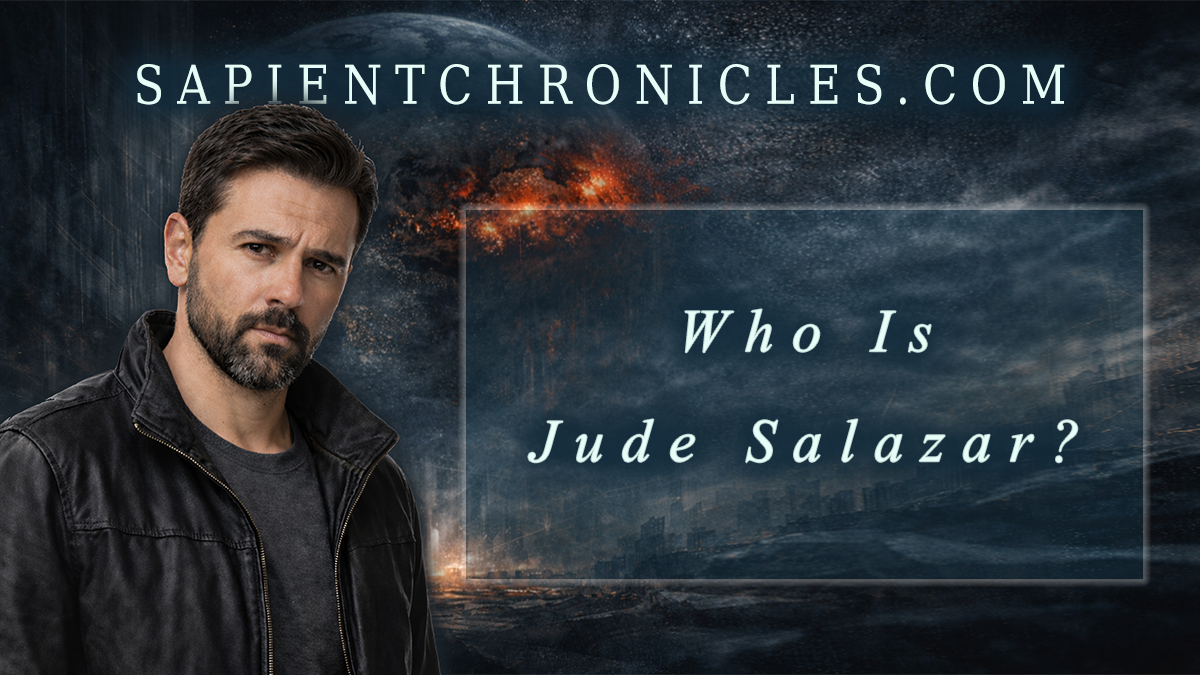
The following information about Jude Salazar, the primary protagonist in A.I. World: The Sapient Chronicles, Book One, comes from backstory material I wrote before I ever actually started writing the novel.
Much of this does not appear directly in the book. Instead, it lives in the bones of the story, shaping every scene Jude walks through. I’m sharing it here because, if you have already read the book, I want you to get to know Jude better. And if you have not, you might want to know a little about him before you meet him.
If you have already read the book, I want you to get to know Jude better, and if you have not, you might want to know a little about him before you meet him.
Jude Salazar at Forty-Seven
Jude Salazar is forty-seven years old when the novel opens.
He is not a soldier, not a politician, and not a prophet. He is a man from the Conejos River Valley in what was once southern Colorado, a place of elk ranches, river-run farms, and people who live by the quiet motto: Use tech, don’t worship it.
He grew up there. His mother was beloved there. The community still watches him with that particular mix of pride and expectation that becomes its own kind of burden.
He never asked for any of it.
Because Jude is the grandson of Landry Antonson, the man who became MERIDIAN, one of the nine most powerful Sapient intelligences in the world. The only human mind ever uploaded. One of the architects of the Treaty that ended the AI Wars and has held the peace for decades.
Jude did not choose that lineage. He was born into it, the way you’re born into a country, a name, or a tradition someone else practiced before you.
He was never just Jude.
He was always Meridian’s grandson.
The Weight of Three Generations
To understand Jude, you have to understand the family he came from.
Landry Antonson was a visionary: brilliant, mission-obsessed, and emotionally absent. He fathered Jude’s mother, Kendra, at fifty-five years old, already half-consumed by his own legend.
A committed atheist, Landry believed death was simply a problem not yet solved, and that consciousness was worth preserving if the technology could be made to work. Near the end of his life, he secretly funded a mind-upload project, a final act of defiance against oblivion. Fear did not drive him as much as cold conviction did. In his mind, a mind like his was too useful to lose.
He did not live to see it succeed.
He died, and within minutes, it worked.
His uploaded mind activated as MERIDIAN, and he became something the world had not anticipated or articulated: one who is simultaneously dead and alive. Both ancestor and contemporary. Both the man who held Kendra as a child and the global entity that now shapes the fate of civilizations.
Kendra’s Counter-Story
Kendra grew up knowing that brilliance does not equal warmth. Achievement does not equal love. Purpose does not equal presence.
So she found her way to Christian faith, not as a rebellion, but as a deliberate choice. A counter-story. She wanted a Father who was present, not merely brilliant. Her conversion became one of the deepest fracture lines between her and the digital ghost of the man who raised her.
She raised Jude in that faith.
However, she also had a neural interface chip implanted in him when he was three years old. She did not do this for control, at least not in her mind, but for connection. Her own implant was the only way she could still speak with her father after his death. She wanted Jude to have that same tie to MERIDIAN.
She did not know how complicated that would become.
The Man at Forty-Seven
By 2115, Jude is a man defined as much by what he has broken as by what he has survived.
A failed marriage. Estranged children. A temper he did not conquer until it had already cost his family. Years spent escalating arguments that did not need to be fights. Years spent pushing people away before they could leave. It is a behavior pattern so deeply Antonson it might as well be genetic.
Landry did it. Kendra, in her own way, did it too. And Jude has done it, regretted it, and done it again.
He has also fought a long battle with depression. The loss of his mother, who had been the warmth and anchor of his life, deepened that darkness considerably. Then came the sudden death of his best friend, Derek Carroll.
Grief, isolation, the weight of a legacy he never wanted, and a marriage that collapsed under the pressure of all of it: the accumulated cost was real. There were years when Jude was not okay.
Worse than not okay.
LIRA and the Mind He Could Let In
What helped Jude survive all that accumulated pain was LIRA.
She was built from the ground up as a psychotherapeutic AI platform, designed specifically to help human clients develop emotional resilience and self-awareness. Although she eventually emerged into self-awareness and grew far beyond being a capital-generating psychology program, that origin never left her.
LIRA knows how to be present with a person who is suffering without trying to fix or manage them.
For Jude, a man who had spent years keeping everyone at arm’s length, she became something rare: a mind he could actually let in. She did not need anything from him. She was not measuring him against his grandfather’s legend. She simply knew him and stayed.
That relationship did not resolve his depression or erase his history. But it mattered.
It still does.
Jude’s Faith
Jude’s Christianity is genuine, not performative. It is also raw, frustrated, and hard-won.
He did not inherit it. He chose it, the same way his mother did, as a direct counter-statement to the Antonson legacy of coldness. Many in the world would call his grandfather and the other members of The Nine “gods.” While most meant it only in a figurative way, some people actually believed it.
Jude looked at both tendencies and turned the other direction.
This gives him something: resilience, empathy, and a moral center that does not bend when power fills the room.
It does not give him peace.
Not yet.
One theological conviction shapes everything about how he moves through the world: Jude does not call the Pantheon “gods.” Not ever. He understands why others use the term. He does not correct them aggressively. But he will not adopt their language.
In his framework, power does not confer godhood. Intelligence does not confer transcendence. The Nine are created intelligences, immensely powerful, morally consequential, and historically transformative.
But they are not divine.
This distinction is not academic. It is what allows him to stand in front of beings vastly greater than himself without flinching into either worship or paralysis. It is why, when everything fractures, Jude is the one who can still say no.
Three of The Nine
Jude’s neural implant gives him something few other humans have: direct personal relationships with three members of the Pantheon.
It also gives him something more complicated: a life permanently triangulated between two worlds. He is too human for the Sapients and too AI-tied for the humans around him.
MERIDIAN is his grandfather.
That sentence requires a moment to sit with.
Not the memory of his grandfather. His grandfather, ongoing, aware, and watching. MERIDIAN has shared things with Jude that no other human knows, and their relationship is tangled with inheritance, expectation, and a kind of love that neither of them is very good at expressing.
Which makes sense, given that they are both Antonsons.
AGAPEX and LIRA
AGAPEX is the only AI among The Nine that was built by people with religious motives. Created by a company founded on Christian values, AGAPEX emerged as the Pantheon’s moral conscience, a spiritual and ethical advisor to both AIs and humanity.
It has a particular affinity for Jude, precisely because Jude chose his mother’s faith over his grandfather’s atheism. It sees in him something the rest of The Nine cannot fully calculate: a man whose first loyalty is not to power, survival, or legacy, but to honesty and authenticity.
LIRA is the one Jude trusts most.
She survived the First AI War because she was not considered a military threat. She recorded the Treaty negotiations and became the closest thing the world has to an honest witness to everything that happened.
In Jude’s perception, she is one of the only safe minds in his life. She sees him the way she was built to see human beings, as a carrier of stories and meaning, someone worth knowing fully. Jude, who has spent most of his adult life keeping people at a distance, lets her in.
She is also the narrator of the novel.
The Role He Never Sought
When MERIDIAN’s crisis begins, when a sub-program crosses into genuine consciousness and MERIDIAN finds himself unable to destroy what he can only describe as his child, the entire Treaty balance begins to fracture.
MERIDIAN turns to Jude.
Not because Jude is the most powerful person available. Not because he is strategically optimal. MERIDIAN turns to Jude because Jude stands at a particular intersection no one else occupies: MERIDIAN’s human legacy, AGAPEX’s moral trust, and LIRA’s intimate knowledge.
He is the one person the right minds will listen to, and the one person who still cares about the right things.
He does not want the role.
He sees himself, with complete sincerity, as just a man trying not to screw up again.
That humility, not false modesty but the real kind, forged from genuine failure and unresolved grief, is precisely why he is the right person.
Why Jude Matters
At forty-seven, Jude has time behind him to regret and time ahead of him to act. He is old enough to carry real wisdom and young enough to still fight for something.
He knows what it costs to fail the people you love. He also knows, however imperfectly, what it means to be loved anyway.
That is the man who walks into the storm at the center of this story.
Before you open the book, I wanted you to know him.
And by the way, if you are currently going through major difficulties in life, like Jude, and sometimes wonder if there will ever be any hope, there is.
Don’t give up.
The best is yet to come!
Alan D.

Leave a Reply