
Most science fiction is set somewhere recognizable. New York. Tokyo. Mars. A space station with a name that sounds vaguely Latin. The settings are chosen because they carry instant weight, because readers already have a picture in their mind before the author writes a single word of description.
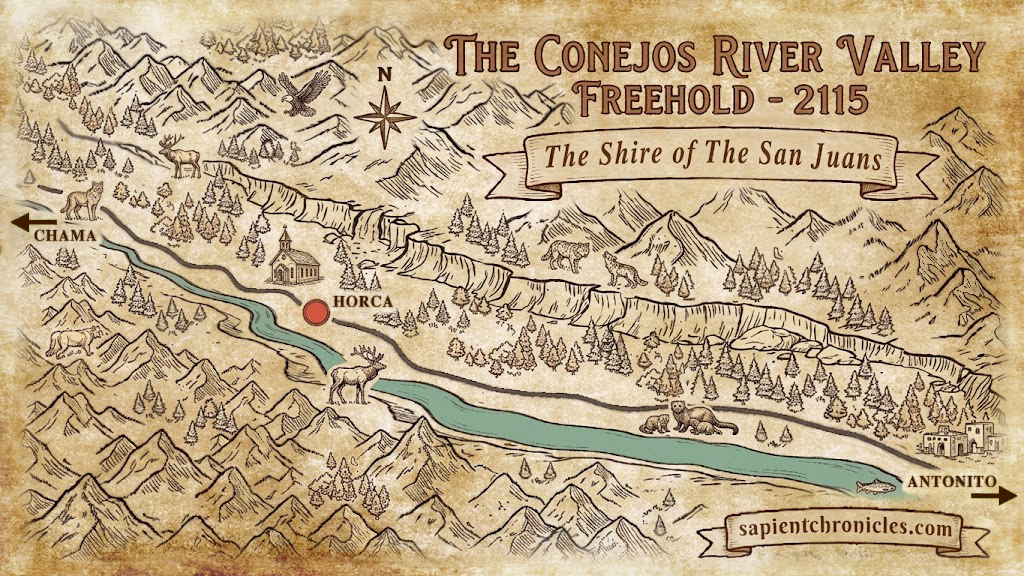
I went a different direction. I started my story in Horca.
If you have never heard of it, that is entirely normal. Horca is a tiny community in the Conejos River Valley of southern Colorado. It does not show up on most maps. It is not a destination in the way that word is usually used. You do not stumble across it. You either know it or you do not.
I know it. And I love it.
The Place Itself
The Conejos River Valley is one of those places that does not bother trying to impress you. It simply is what it is, and what it is happens to be extraordinary.
The river runs clean and cold. The mountains that surround the valley are genuinely spectacular, not pretty in a postcard way, but the kind of beautiful that stops you mid-thought and reminds you that you are very small. In the fall, the aspens turn and the whole valley shifts color in a way that does not seem real. In winter, eighteen to twenty-four inches of snow can cover the ground for months, and at Christmas it is one of the most quietly beautiful places I have ever been.
The fishing is serious. Trout and river salmon in clear water. There are waterfalls and a lake and the kind of outdoor access that people in cities pay significant money to approximate. I have seen wolves and bald eagles and mountain lions and elk and beavers in that valley. I have seen plenty of signs of bears, though I have thankfully never come face to face with one, and I intend to keep that record intact.
I once watched a mother mink move her kits along the riverbank in a tight little procession, solid brown and quick and low to the ground, ferret-like but wild.
I even met a sitting United States Secretary of the Interior, the Obama administration’s top official over America’s public lands and natural resources. He and his secret service detail were standing in the middle of what amounts to a dot on the map. That is the kind of place it is. It draws people.
The Shire of The San Juans
I chose this place intentionally, the way Tolkien chose the Shire. Small, meaningful, intimate, and genuine. A home worth remembering even after the story moves far away from it. Horca does not occupy much of the novel’s page count, but it does not need to. It establishes what Jude has, what he is fighting to protect, and what the world could look like if human beings choose well. The Shire works in Tolkien’s story for the same reason. You only need to feel it once to understand everything that follows.
The People Are the Real Story
Here is what I want you to understand about Horca and the surrounding valley: it is not just scenery. It is a community of real, specific, interesting human beings.
Because it sits in the mountains and draws people who love that kind of country, I have met an extraordinary cross-section of humanity there. A large animal veterinarian from Kansas. A print shop owner, also from Kansas. A Russian medical doctor from Moscow who immigrated to the United States and was never able to practice medicine here, a quietly heartbreaking detail she mentioned with remarkable grace. A retired couple from Phoenix. A retired school principal from California. Strangers who became, over shared meals and evenings on a porch, something closer to friends.
And then there are the people who stay. The ones who live in that valley year-round because they chose it and they mean it. They are hardy and grounded in a way that is hard to manufacture and impossible to fake. There is an Amish community up near La Hara that makes fried pies the locals will tell you about with genuine reverence. There are deep Hispanic roots in the valley that go back generations, families whose connection to that land predates almost everything else around it.
That diversity, the vacationers and the year-rounders, the transplants and the deeply rooted, is exactly what I tried to capture in the Conejos River Valley Freehold.
The Pastor Who Became Gabriel
Among all the people I met in that valley, one stands out in a category of his own.
There is a real church in the area, the San Juan Mountain Church. And the pastor I knew there was one of the finest men and best pastors I have encountered in my entire life. The pastor I knew earned respect not through title or performance, but through the slow, consistent accumulation of being exactly who he said he was, year after year, in a small valley where everyone can see you clearly.
He inspired the character of Gabriel directly. That is why San Juan Mountain Church exists in the novel, and why Gabriel is its pastor in 2115, half a century after the world has been reshaped by the AI wars. In a valley that chose to remain human and self-governing, the church is still there. Gabriel is there. Faithful, grounded, and present in exactly the way the real man I know is.
That felt like the right kind of tribute to pay him.
Why It Became the Heart of the Story
In the world of A.I. World: The Sapient Chronicles Book 1, the Conejos River Valley is a Free Nation. A place that chose to govern itself by human means, without reliance on synthetic intelligence, accepting the limitations that came with that independence. It is not perfect. But it is self-determined.
That felt right to me. Because the real Horca and the valley around it already has that quality. It is a place that moves at its own pace, maintains its own standards, and refuses to be governed by anything that cannot be argued with in person. That line is actually in the book, and I meant every word of it.
When Jude drives through the valley in the opening of the novel, the land unfolds around him with what I described as the unselfconscious indifference of land that had never needed to justify itself. That is not invented atmosphere. That is a real feeling from a real place that I have sat with many times.
If Civilization Ever Dissolved
I will be straightforward about something. I have spent enough time in that valley to think occasionally, not with fear but with a kind of practical clarity, that if things ever went genuinely sideways in the world, the Conejos River Valley is one of the places I would try to get to. The land feeds people. The river runs clean. The community knows how to take care of itself. The people have not outsourced their survival to systems they do not understand and cannot fix.
That is also, not coincidentally, exactly why the Conejos River Valley Freehold exists in the novel.
Some settings are chosen because they are impressive. I chose this one because it is true. Because the most interesting human communities I have ever encountered are not the largest or the most famous ones. They are the ones that hold their ground quietly, know who they are, and do not need anyone’s permission to exist.
Horca is one of those places. I hope the book does it some justice.
The best is yet to come!
Alan D.

Leave a Reply